Showing posts with label mom. Show all posts

Thursday, August 21, 2014

to be sorted later

I’ve been writing a lot of emails to myself lately. Mostly, I’m sending articles, essays, and short stories, but I’m also sending notes, quotes, and music. I get a strange kick out of emailing myself, because while on the one hand it seems like a completely logical method of reminding oneself to do something, on the other hand, it feels and is completely ridiculous. “Dear Me, read this later.”

These things that I've been emailing Me are not at all related to one another, really—mostly they're just different things that interest me and that have threatened to destroy my productivity at work on that given day. So instead of letting the Internet win, I have created a chain of emails to myself, all under the subject line "to be sorted later," not that I know what it is exactly I plan on sorting later.
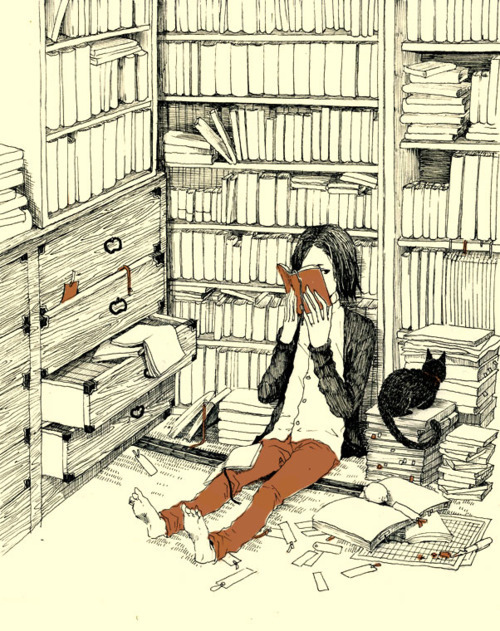
(Source: violetas-verdes)
Currently, I am planning to sort the following things out later: a recent short story in the New Yorker, submission guidelines for a website that I'd like to write for, two writers' tumblrs, an interview with one of those writers, and something about Lars Von Trier, and something about walking. Specifically, something. One email says only, "LARS VON TRIER - ?" and “on walking…”

Yes, I am aware I sent these notes to myself, so I probably should know what these things mean. But I don't. Well, I sort of do. Two Sundays ago I watched "Nymphomaniac," Volumes 1 and 2, and it left me feeling odd and unsure of my feelings and vaguely disturbed, but not as disturbed as I thought maybe I was supposed to feel. I think I wanted some critic to tell me if Von Trier was a misogynist or pro-woman. Then I thought that maybe I should be an adult, and come to my own conclusions. Then I got annoyed by the whole thing and put the question of Lars Von Trier out of my mind entirely.

As for the "on walking..." note, your guess is as good as mine. I like to walk?

Moving on: I still have more to sort. Come to think of it, I haven’t actually sorted any of these things yet. I haven’t read that short story yet. I haven’t yet read Roxane Gay’s piece in The Guardian about Ferguson. I still haven’t read the poem “The Lost Art of Letter Writing,” for fucks sakes!

(via razorbladesalvations-deactivate)

One of my problems is that I want to read everything at once. Sometimes this gets more out of hand than others. I still haven’t finished my summer Shakespeare project. My brother and I are in our third year of doing this. We pick a different Shakespeare play each summer to read, and then we might talk about it a lot, or a little, or not at all. The point is the reading of it, mainly. Jay texted me three weeks ago, saying, “Finished Lear” and still, I’m not done. The underachieving younger sister strikes again! Ha, ha.

It’s no wonder I haven’t finished King Lear yet. I’m also currently reading: The Yellow Eyes of Crocodiles, Living History (because I felt it was required reading before reading Hillary Clinton’s latest book), and Bad Feminist. Oh, and A Wrinkle in Time, because I learned it was going to be made into a movie, so of course I needed to read it again. (My most recent reading of it was in 2010. I am insane.) I’m supposed to be halfway through another book, Cutting for Stone, as part of a book club my friend Natalie invited me to join. I haven’t opened the book. It is 658 pages long.

I’d say I’m not always like this, but I’m always like this. I have a permanent stack of books. The other night I grabbed Malcolm X: A Life of Reinvention off the shelf, and then The Dream Songs, and then I realized I had two other books, and my journal, in my hand. And then you add the Internets, including access to the New Yorker archive (!) to this equation, and that’s it. I’m dead.

Sometimes I feel like I’ll never get around to sorting it all out later. Constantly, I’m reminded of my mother, sitting in her green chair, which is now my green chair, with a stack of books on the floor next to her. She had bookmarks in all of them, including Les Miserables, which I stole from the pile after my mother died. I’ve added it to my own stack of books from time to time over the last 12 years, but it never makes the cut. It always ends back on the bookshelf, to be sorted later.

(via brittanickel)

Monday, May 12, 2014

'Like a Last Rain' on Mother's Day

“And what about those who don’t have a mother?” “The Unmothered,” by Ruth Margalit, The New Yorker, May 9, 2014

Last week an acquaintance of mine asked if I was celebrating Mother’s Day. I was caught off-guard. We were on the bus, and had been making small talk prior to this question; I hadn’t eaten any breakfast that morning; and I was not at all prepared to be reminded that one of my least favorite days of the year was on the horizon.

“No,” I said flatly. He looked away for a moment. I decided to be a normal human being and try again. I asked, brightly, “What about you? Does your mother live nearby?”

I knew it was safe to ask about his mother, because his upbeat and unassuming way of asking about the holiday made it clear he had a mother around to celebrate. I was right, of course. He told me about his lovely plans with his family and I continued to smile, wondering if it was at all obvious that inside, I was screaming.

The conversation moved on, as conversations do, and soon enough I got off the bus and walked toward my office, feeling more annoyed with myself than anything else. Sooner or later, I tell myself, I’ll handle these types of questions with grace. And maybe I almost did, this time. I’m not really sure. But what was my alternative? Drop the “No, my mom is dead” bomb in the middle of the 66 bus at 9 a.m.? No thank you. I guess I’ll just sound like a jerk.

With each passing Mother’s Day that Mother’s Day continues to, somehow, exist in this world without my mother alive, I convince myself that this year, I won’t have these moments. I won’t have the conversation I manage to have every year, where some perfectly nice, clueless person who still has a mother and doesn’t really know me asks about my Mother’s Day plans. (I wrote about this dilemma on this very blog four years ago, actually.)

All of this is to say that I’m fine. No, really, I’m fine.


“Trust me, I’m too aware of the fact that my mother is gone to wish her here in any serious way on Mother’s Day. But does the holiday have to be in May, when the lilacs are in full bloom? When a gentle breeze stirs—the kind of breeze that reminds me of days when she would recline on a deck chair on our Jerusalem porch, head tilted back, urging me to ‘sit a while’?”


Mother’s Day often has a way of making me feel very alone in this world. That, of course, is insane. Over the course of the day, I got thoughtful texts and messages from different women in my life who are the proof that I am far from alone: my aunt Deborah; my cousin Micaela; my sister-in-law Tina; my friends Lauren and Natalie. But to not have my mother here on this Earth is to feel a specific sort of aloneness, something that, in spite of all the messages in the world, can never be replaced. This reality used to—and sometimes, on low days, still will—fill me with despair.

That feeling began to threaten me yesterday, if only for a brief moment. I started to feel the sadness take over. I made coffee and didn’t drink any of it. Everything had been fine, but then it was not fine. I sat down at my computer and found this article that I keep quoting here. I thought it would make me feel better, and it would have had I let it, but after I read it I just felt vaguely sick, nauseous. I went outside to my back porch and sat directly in the sun, my bare legs prickling from the heat for the first time in a year. I looked up and squinted into the sun.

I knew what I needed to do. I went back inside to get my phone so I could call my dad. I saw that he had already beat me to the punch, with a short text that said nothing and everything: “hey al hope you’re having a good weekend.”

I went back to my piece of sunshine and called him. The feeling that had threatened to turn this day into a nightmare faded. He is still here. It’s okay. It really is.

The sun was hot on my face. I was not alone.


"What is the death of a loved one if not an oxymoron? My mother isn’t here, and yet I see her everywhere. I kept on looking for hints of her on the page, as though by retracing her beloved books and poems I would get to reclaim a part of her that was already slipping away."


Later in the afternoon the weather shifted from warm sunshine to a cool thunderstorm. When the weather turned, I curled up with my cat Layla next to the open window, the blinds flapping gently from the breeze. I found a movie that I knew Mom and I had watched together, more than once—Sense and Sensibility.

Mom was not there.

Or was she? Next to my television, the framed photo of the two of us at my high school graduation stared back at me. In it, our cheeks are pressed together; our smiles are big. We look just alike. I remember, that spring, counting down the days until I would graduate. If only she can stay healthy to see me graduate, I would think. We made it to graduation. She made it even through that long, hot summer, to come move me in my college dorm. But that would be it. There would be no more landmark moments after that. No more. We’re done.

These thoughts are exhausting. These are the thoughts that take over on Mother's Day. I stared at our photo, not even paying attention to the movie, and I remember posing for it. I remember the feeling of my mother’s warm cheek against mine. I tell myself I remember.

Emma Thompson and Kate Winslet were still talking about something or other on my television screen. I stopped thinking and staring altogether and fell asleep, my fat cat’s paw resting in my hand.

When I woke up from my nap, the feelings were gone. The rain had stopped. The day was once again, just another day.

And I will miss my mom again tomorrow. And then again the next day. And all the days after. But it doesn’t have to be a Day. It just is. We keep on living.


“There’s a word in Hebrew—malkosh—that means 'last rain.' It’s a word that only means something in places like Israel, where there’s a clear distinction between winter and the long, dry stretch of summer. It’s a word, too, that can only be applied in retrospect. When it’s raining, you have no way of knowing that the falling drops would be the last ones of the year. But then time goes by, the clouds clear, and you realize that that rain shower was the one. Having a mother—being mothered—is similar, in a way. It’s a term that I only fully grasp now, with the thirst of hindsight: who she was, who I was for her, what she has equipped me with.

Like a last rain, my mother left behind an earthy scent that lingered long after she was gone.

Like a last rain, for a fleeting moment, everything she touched seemed to glow.”

Monday, March 31, 2014

The Trumpet Player

Outside my apartment, but somewhere just out of view from my windows when I peer between the blinds, someone is playing a trumpet. This person does not know how to play a trumpet. At least, this person does not know how to play a trumpet well. Every other a minute, after a few (semi) successful notes, I hear those sharp, painful squeaks one might associate with sounds coming from a middle school band practice room.

With each new squeak, Mufasa, my cat, jerks her head around wildly. At first I was trying to drown out this noise with music, but now I’ve put it on pause, indefinitely.

The trumpet player has started to shout, or laugh, after each screw-up. At first I was confused: Am I imagining all this? Are the neighbor kids playing a prank? (I guess now that I’m 30, I legitimately have thoughts that include “the neighbor kids”?)

After one of the most offensive of the squeaks thus far, someone clapped. A dog barked—yipped, rather. Another squeak.

But then. Then! Back to the playing.

It’s been about 20 minutes. The squeaks are not as constant. Below the dim of traffic passing on California Avenue, I can hear it. The playing continues. It’s fainter, now, but steady. Every so often, there’s another squeak. Another shout. The playing goes on.


When I was about 8 years old, my mother bought a used piano. She had taken lessons as a child, but she decided she wanted to practice again. Whether this urge was driven by her purchase of the piano, or vice versa, I’m not sure. Regardless, she was going to take lessons, and as such, so would my brother Jay and me.

While my talent for the piano never went much past repeated one-handed playings of the Tarantella, or my other favorite, songs from The Little Mermaid book, my mother continued to practice. Our miniature poodle Tinker was not a fan of her playing. In particular, the dog was less than fond of her repeated attempts at learning to play Für Elise on Saturday afternoons.

From my bedroom, a short hallway away, I’d often be reading a book when Mom would take up her playing. She wasn’t bad, really; she just reached a point in the song where she’d miss her key, and then Tinker’s whine would get louder. She’d stop, yell at the dog, then start over. With each new beginning, she’d play the start with renewed confidence. You could hear it. I’d perk up a bit as I’d rest my book in my lap, listening. And then, the fumble. The dog whining. This would continue, until finally I’d hear her close the piano and open the front door to let “the damn dog out.”

Those opening notes of Für Elise have been burned on my brain since childhood. I can even picture her sitting at the piano, her posture perfect, just as it was whenever she sat at the computer.

She never did master the song. But better still, the memory of her perfect posture; the intensity with each fresh start; even her annoyance at the poor dog.


It’s quiet, now. The cars pass by on California Avenue. Mufasa is asleep, next to me, her head resting on my knee.

The trumpet player has retired for the evening.

Monday, January 27, 2014

Monday Mix Tapes: Toni, Babyface, and Another Time

Next Tuesday, all my dreams come true.

That's right! On 2.4.14, Toni Braxton and Babyface are releasing their duet album, Love, Marriage & Divorce. 

About damn time. Cause, duh:


Look, I know I'm being a little flip about this whole thing, but I should probably be clear that my heart aches every time I listen to this song. (And I've been listening to it, often.)

Not only do I absolutely love Babyface and Toni Braxton collaborating with every fiber of my being, every time I listen to Toni Braxton sing, I'm transported to a different time. A time when I'd put my mother's Toni Braxton CD on in our living room while we'd be cleaning the house on a Saturday afternoon. A time when I so often snagged her Waiting to Exhale soundtrack to play in my room, she finally laughed and told me to just keep it.

So yes, while I can only assume that this duet album will be jam-packed with tunes to make my heart ache about love and romance and breakups (unless of course it's just an incredibly misleading album title), it's also going to make my heart ache in a wonderful, separate way.

It's like hearing my mom laugh again. It's the two of us in my little Dodge Neon, and her turning up the radio to one of our favorite R&B songs and tapping her hand on her oxygen tank to the beat.

I couldn't be more excited.

So let's take it back for a minute to one of mine and my mom's favorite Toni Braxton songs.


Wednesday, December 11, 2013

Tis the Season

I am really getting in the Christmas spirit this year. Maybe it’s my new Christmas tree. Maybe it’s because my annual reading of Holidays on Ice had me laughing my ass off on the train to myself even more than usual. Maybe it’s my “Let It Snow” Spotify playlist. Maybe it’s from watching Christmas Vacation on a twice-weekly basis and texting quotes to my cousins nonstop.

Whatever it is, I’m going with it.

Yesterday I read this article, “The sentimental, cynical, undying charm of A Christmas Story,” in which the writer makes a lot of wonderful points, not just about that movie, but about the holidays in general. She writes:

"But what happens after that perfect Christmas, when you get the ultimate shiny, exciting thing you asked for, then realize it can’t get better than this? A Christmas Story doesn’t say, but we adults know what happens: The wanting of mere things starts to lose its glittery seasonal appeal. The magic of childhood yuletide fades, and eventually morphs into something else.

There’s a moment in the season-two Christmas episode of The Wonder Years—a TV series that does a much more sentimental version of the narrated-flashback trick from A Christmas Story—when narrator Kevin Arnold describes that transformation as one where the holiday stops “being about tinsel and wrapping paper” and starts “being about memory.” If you believe that’s what happens to Christmas when we grow up, then it makes total sense that narrator Ralphie looks back on the Christmas Story December with such wry wistfulness. It’s because very soon after, possibly the following year, Christmas turned into a time for him to look back, instead of looking forward.

The warm, achingly bright glow of nostalgia is what makes Christmas such an emotional holiday, and it’s also what draws some people to A Christmas Story."

First off, anyone who references The Wonder Years in an article about anything knows exactly what she’s talking about, in my humble opinion. But it’s the part about “the warm, achingly bright glow of nostalgia” that I think is so on point.

My childhood was packed with special Christmas memories. Going to my grandparent’s house on Christmas Eve, with our “Christmas Classics” or “A Very Special Christmas” tapes blaring in the station wagon (later, the Taurus). My brother and I would sing along to Jim Nabors’ “Go Tell It On the Mountain” and Run DMC’s “Christmas Is,” laughing hysterically to ourselves. While at my grandparent’s, we’d all help decorate their tree, one with those absurdly enormous multicolor bulbs and silver tinsel that got everywhere. My grandma would always let me set up the nativity scene on the windowsill, something that filled my child heart with joy and pride. On the way home, we’d usually give my great-grandma, Nannie, a ride home, and Mom would sit in the backseat next to me, a blanket over us as I rested my head on her shoulder and we looked out the car window in awe at all the Christmas lights on the houses.

On Christmas morning, my brother would run to my room to wake me up at an ungodly early hour, where we’d immediately run to the living room and squeal over our newly-filled stockings and presents under the tree. Then we’d run to our parent’s room, where we’d immediately get shot down about them getting up at 5 a.m. to open presents.

So we’d put on the shortest Christmas movie imaginable—typically, How The Grinch Stole Christmas (what is that, like 35 minutes long?)—and then run back again to wake them up. By this point, they’d usually cave, and as they made their coffee, we’d start passing out the presents. Stockings came first, followed by the presents. I always got to start the rotation of unwrapping, because I was the youngest.

Usually after all the presents were unwrapped, you’d find me in the recliner, already reading one of my new books while surrounded by wrapping paper. Next would be a Christmas breakfast, also marking the moment when Dad would inevitably try to play his Three Tenors Christmas album or Mom would try for Gloria Estefan. Afterward, we’d spend the day with my dad’s side of the family, which included two of my favorite Christmas memories with my Grandma Hamm—the year she gave me sugar cookie dough as a gift, and then the infamous year when she gave my younger cousin Claire peanut butter, which Claire promptly started eating with her fingers in the middle of the room, much to the aggravation of my Aunt Linda and the delight of me.

The point is: I was one lucky kid. I don’t have any sad or bad memories of the holidays, just ones like these. The last year my mother was alive, I was 17, a senior in high school. She almost died of a blood infection just a week before Christmas, but by Christmas Day, she was back home, feeling better—or at least putting on a hell of a show for all of us. I actually got sick that year, coming down with a fever on Christmas Eve, and I unwrapped those final presents with my mom in the room with a cold washcloth on my forehead, burning up with fever. But it didn’t matter: she was there. We were all together. It was a gift.


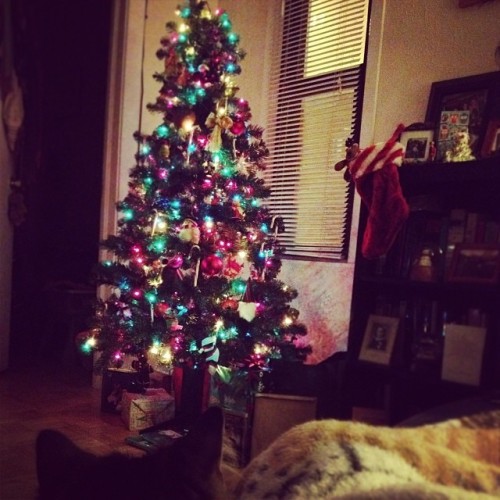
The holidays were the hardest after she was gone. They’re still hard. But we’ve had a lot of time for new traditions, and new family members to celebrate with, like my dad’s girlfriend, Debbie, who insisted I needed a Christmas tree for my apartment and knew just how much I would love to have some of my mom’s old ornaments. We have my one-year-old niece Polly, who could make even the coldest Grinch smile when she winks one of her gorgeous brown eyes, one of her new tricks. (I can only assume she'll be reading Dickens by her 3rd Christmas.)

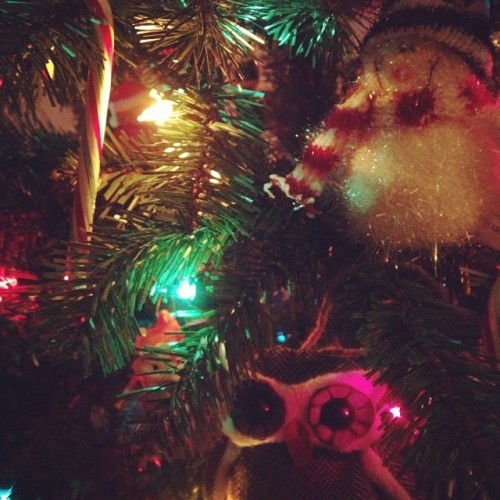
So yes, I get a little emotional at the holidays, like when I burst into tears when I found the snowman ornament, the last ornament I ever picked out with my mom. I miss her terribly at this time of year. But I also know that I will always have those memories with family, and more to create with family and friends. Nothing can take away the memory of leaning my head on my mother’s shoulder, and staring at the holiday lights with delight.

Happy holidays to you all, and I hope, if there’s anyone special you’re missing this season, you have great memories to cherish, knowing that no matter how much time passes, those will always remain.

Now let’s drink some eggnog and make merry! It's getting too real around here.

And don’t forget:

“And when Santa squeezes his fat white ass down that chimney tonight, he's gonna find the jolliest bunch of assholes this side of the nuthouse!”

Wednesday, September 11, 2013

THE LAMP

The lamp next to my bed is broken on the top, and tilts slightly to the side. A crack runs across the top, past the jagged edges from where the glass had shattered.

I love it. I cannot bear the thought of ever having a different one. (I used to have two. But the other one, that matched it, broke as well, years ago. Back when the breaking of such a lamp was just an annoyance rather than a complete devastation.)

I still remember how I felt after my then-boyfriend knocked the lamp off the nightstand, as I kneeled on the carpet in my bare feet, picking up shards of glass. I don’t remember why it got knocked over, though. Was it a careless gesture during a fight? Was it from a drunken stumbling? I can’t remember. I just remember how I felt, picking up the shards. Knowing it was never going to be perfect again.

It’s dangerous to leave it, he said. The edges of the glass are sharp.

I don’t care, I don’t care, I don’t care!

I hated him for breaking the lamp. I hated me for caring so much about a stupid lamp.

But:

It was my lamp. My mother had bought the two lamps for me, to match my new, big bedroom after my parents expanded our house. I had been so special, with my new, huge room. To get to my new room, you had to walk through a hallway—and to the left, right before my new room, was my bathroom. My own bathroom, with my own shower.

I was special, then. I was a child.

The matching lamps—one for the nightstand, one for the dresser—reminded me of the ones that had been in my grandma’s bedroom. Antique (looking, at least), with two globes, one big, one small. If you twisted the knob in the middle once (one click to the right), the bottom, small globe would glow. One more click, and the top would, too. Another click: both, glowing. The lamps were flowered, much "girlier" than most things I liked. But I loved the clicking: one, two, three.

I’d put my book down next to the lamp when it was time to go to sleep. One last click, and then darkness.

The lamp is broken on the top now, and tilts to the side. A crack runs across the top, past the jagged edges from where the glass had shattered.

But I still love the clicking: one, two, three. I still put my book down next to it when it is time to go to sleep. With one last click, darkness.

It reminds me that at one time, I had a mother who bought me two matching lamps, to match my new, big bedroom.

And that is something. That is special, still.

This post is part of a little writing experiment inspired by Ray Bradbury, to "conjure the nouns"—read more details here. Former entry: The Mouse.

Sunday, June 9, 2013

A Big Open Book Between Us


“Some changes happen deep down inside of you. And the truth is, only you know about them. Maybe that's the way it's supposed to be.” — Judy Blume, Tiger Eyes


When I was a kid, my mother loved to take pictures of me reading books. Curled up in the recliner on Christmas morning, reading a new book while still in my pajamas; stretched out on a towel on Wrightsville Beach; laying across the floor at Grandma Hamm’s house. All with a book in my hands.

I didn’t realize just how many times she’d taken photos like this until I graduated from high school, and she gave me a present: A photo album that chronicled my life so far. All 18 years of it. And on almost every other page, I’d find these sorts of photos.

My favorite, though, is one that my mother didn’t take. That’s because she’s in it. It’s from 1995. We were at my Uncle Gary and Aunt Deborah’s house, probably for Thanksgiving. I love it because of our matching smiles, dorky glasses, and the way we both have one hand placed on the big book open between us. Mostly I love it because it says so much.

I couldn’t tell you what the book was, but I do remember the comfort, the safety, of being curled up next to my mom on a couch, reading a book. I’ve loved reading for as long as I can remember—even when I wasn’t technically reading, but as I listened to her as she read us The Berenstain Bears books, my brother Jay and I on either side of her.

It started with the Berenstains. Later, we had Laura Ingalls, Nancy Drew, and Trixie Belden. And then: Margaret. Steph. Deenie. Sally J. Freedman. Karen.

If you grew up in the 70s or 80s, you might have recognized many of those names. They’re all characters from Judy Blume books. By the time I became familiar with these girls, I’d outgrown the nighttime ritual of Mom sitting at the end of my loft bed, reading me Little House on the Prairie books or her old Trixie Belden’s.

But it was because of my mom that I did get to know them. And when I say get to know them, I mean exactly that. Like so many other young girls, I devoured Judy Blume’s books—always finding something in each protagonist that I would identify with so deeply, so intensely, I’d think, How did she know? or, It’s not only me!

Then, in high school, I snagged Mom’s paperback of Summer Sisters. I fell in love with it. I fell in love with Vix, the main character. I obsessed over Caitlyn, her “summer sister,” just like Vix did—and resented her, too. It felt real.

I’ve read Summer Sisters almost every single summer since that first reading. I took it to Wrightsville Beach, the summer after Mom had died, when it was just Dad and me. I sat on the balcony of our hotel reading it, just like Mom had sat reading books so many different summers when we had visited, all as a family. Reading it was like taking a vacation from my heartbreak. I didn’t feel sad or angry or confused. Everything felt right again.

I owe my mom and Judy Blume for that gift. From my mother, I have my love of reading, a lifelong comfort. When I want to talk to my mom sometimes so badly that my chest actually hurts, I can pick up a book and feel okay again—or at least not think about it anymore. And obviously, so many women have Judy to thank for writing the stories she has, for sharing these characters that so many of us can find ourselves in, even if it’s in a small way.


Last night, I had the absolute thrill of meeting Judy Blume. She finally made a movie out of one of her books, Tiger Eyes. Out of all of her books, she had to make a movie out of the one I never read! The movie played at a theater nearby last night, and Judy Blume was there for a Q&A session following the screening.

She was wonderful. She was down to earth, kind, and full of joy. She choked up talking about how meaningful this story was to her. She talked about her son, Larry, who directed the movie, with such love in her voice. When the Q&A was over, even though she had made a comment about how exhausted she was from all of her traveling and weekend’s events, she still stayed and talked to the people (mostly women), who were lined up waiting to meet her. My favorite was the woman, probably my age or younger, who was standing behind me, clutching a beat up paperback of Starring Sally J. Freedman as Herself. She’d had her mother FedEx it to her so she could have Judy sign it.

As for me, I stood clutching Mom’s now very worn paperback of Summer Sisters. I nervously handed it to one of my lifelong heroes and asked her if she would sign it, telling her it had been my mother’s.

Judy flipped to the title page and sort of raised her eyebrow at me before she started to sign. “You must have been pretty young when this came out.” Then she laughed. “And I was 60!”

It was a quick moment, and nothing extraordinary. But to me, it was extraordinary. Like this wonderful writer (and person) wrote in Tiger Eyes, “Some changes happen deep down inside of you. And the truth is, only you know about them.”

No one but me knew that at that moment, I felt as content as I did sitting on a hotel balcony reading my mother’s old paperback. No one but me knew that for just that quick moment, meeting Judy Blume, I felt like I could almost hear my mom laugh again. Almost. And it was enough, almost.

I think of Davey, the protagonist of Tiger Eyes, so distraught over the death of her dad, but yet still so strong. At the end of the movie, she dives in the ocean and swims. You know she’s going to be okay.

Thanks to a little help from Judy Blume, so many of us know the same.


Thursday, March 21, 2013

Every Night I Ask Myself...

Local Natives played in Chicago tonight. I was originally planning to go, but that didn't work out.

Maybe it's for the best.

I’ve been listening to their new album repeatedly since it was released, so much so that it’s become deeply personal, and almost representative of these last few months of my life, strange as that may sound. And since most of that listening has been through my ear buds, riding the train and walking to work, it’s also become an album that for me, speaks specifically to my solitude as well. It's how I feel bundled up against the harsh Chicago winter wind. It's how I feel, being alone with my thoughts as I walk to work in the mornings.

I know that if I start playing Hummingbird, the new album, right as I step out the door on the way to work, by the time I get to the elevators at my office building, the last song, "Bowery," will have just started. I know this, because I've been doing it at least once a week for the last two months.

One day, one of the first days, "Breakers" came on and I was so excited, I couldn't stop grinning as I stood, alone on the crowded train.

One day, one of the worst days, I listened to "You & I" and pressed my cheek against the cold train window. I didn't realize I was crying until I caught a woman staring at me, with that specific, kind sense of worry in her eyes that nice people give strangers they see crying in public. So I decided to just keep crying, because I needed to cry and because the songs were asking all my questions for me.

"When did your love, when did your love grow cold? The closer I get, the farther I have to fall..."

It’s funny how I can love an album so much when it makes me feel so deeply sad. But perhaps sad isn’t the right word. The album also makes me really damn happy. (I swear.)

But there's something about these songs. I feel it in almost every one. A yearning for something. Another fan said to me: "It's definitely a breakup album."

Maybe. But it's so much more than that. It makes me feel a yearning for so many things—things that I know I can't have, and things I didn't even realize I missed or wanted until that moment I hear it through the song. Either way, it's a feeling of wanting, of needing, something that seems just out of reach. But maybe if we keep listening, we'll get there.

***

The song "Colombia" begins with a slow, steady piano, and the words:

"The day after I had counted down all of your breaths down until
There were none, were none, were none, were none;
A hummingbird crashed right in front of me and I understood all you did for us."


From my first listen, I knew immediately what it was about.

I wanted to be wrong. But I wasn't. It's a song for vocalist Kelcey Ayers' mother, who passed away in 2012, and as the song builds, and builds, I'll be damned if you can't feel every ounce of his loss come through every plea.

"Ohhh, every night I ask myself
Am I loving enough?

Am I loving enough?

Patricia, every night I'll ask myself
Am I giving enough?
Am I?"


I can't tell you how many times I've listened to this song. I can't tell you how many times I ask myself those same questions.

***

The Saturday morning the tickets went on sale, we’d been out late at another show the night before. But we were serious about getting these tickets. He'd set an alarm on his phone to make sure to buy our tickets as soon as they went on sale. When the alarm went off at 10 am, he got out of bed, grabbed his laptop and carried it over, and bought us our tickets from bed.

A little bit later we walked to get breakfast, and the sun was shining. It was bright, too bright for how cold it really was. Our fingers were interlocked together but we were a million miles apart.

Across the booth from him at the diner, I gripped my coffee mug and looked down, and then up at him, trying to read his eyes. He smiled at me, but his eyes didn’t. I had a feeling, then, that maybe we weren't actually going to go see Local Natives together in March.

Because his eyes said everything that I knew he wasn't going to say. Or at least wasn't going to say again, not when the sun was so goddamn bright and it was so cold outside and all I could taste was the coffee on my tongue.

Later that day, I played "Heavy Feet" as I walked down the street away from his place, and to the train.


"After everything, after everything/left in the sun shivering"


***
The album comes to a close with "Bowery," which is perfect. ("Can't tell if the ceiling is rising or if the floor is falling down.")

I'm sure Local Natives put on a beautiful performance tonight. But I'm okay, right here.


"At the time I wasn't with you

At the time I didn't care."

Wednesday, October 31, 2012

A Long Overdue “To Do”

I write a lot of “to do” lists. They’re pretty much always the same—and I pretty much almost always still forget, or neglect, to do half of the things on it. But I still get a little thrill when I draw a line through one of them, marking it off: Yoga. Laundry.

One that I haven’t marked off in far too long is one that makes the top of the list nearly every time. That “to do” is “Write Grandma E”—that is, my Grandma Exckhardt, my mother’s mother. Aside from the fact that I’ve run out of stationary for the first time in a decade, I don’t have one good reason to not mark this off the list every time. Especially since every time I do mark that off the list, and drop that letter in the mail, I feel really happy.

This evening, while on the phone with my dad, he rather politely reminded me of this neglect, hinting that maybe I hadn’t been in touch with Grandma recently, and that maybe, just maybe, that might hurt her feelings. My heart lurched as soon as I realized he was right: When was the last time I had written Grandma?

It’s been months.

When we got off the phone I paced around my kitchen for a minute, feeling awful. Should I call now? But no, it’s too late—I’ll probably just wake her up. Then I thought, I’ll write her a letter right now. I’ll mail it tomorrow; she should get it by Saturday.

This plan didn’t seem good enough, either, so I vowed to myself that I’d call tomorrow, either on my lunch break or as soon as I got home from work.

Whether your line of thought right now is either “Wow, calm down” or “Geez, can’t you even take the time to call your own grandmother?”—I don’t really blame you for either. On the one hand: Calm down. I can rectify this. On the other: Can’t I take the time to call my own grandmother?

I’m bad at keeping in touch. If it weren’t for Facebook and email, I’m sure plenty of people would forget I even exist. I’m that bad.

But: my grandma doesn’t use the Internet. She also doesn’t live in Chicago. She lives in Muncie, Indiana, and she and my grandpa spend the winters in Florida with my aunt. Hence, the importance of the letters or phone calls. Neither of which I’ve been doing.

You should know something about my Grandma E: She is thoughtful.

And when I say thoughtful, I mean thoughtful. One year I told her how good the birthday cake she made for my party was, and she made the exact same cake the following year. Based on one offhand comment! Because she knows how much I love devilled eggs—and hers in particular—she makes some every single time she knows she’s going to see me. Every time. Even if she’s not hosting the get together. She does it because she knows I love them. She has done this for years.

There’s nothing that’ll really make you feel worse than acting less than thoughtful to a person who is always thoughtful to you. Know what I mean?

But it’s more than that. Because there’s another thing you should know about my Grandma E: my mother adored her.

Well, duh—that’s her mother. But, whenever my mom talked about her, whenever my mom was around her, even as a kid, I could feel not only the love between them, but also the respect that my mother had for her. They had a special bond, perhaps not unlike the bond I felt with my mom.

Monday, October 29, 2012

How Do You Know Who You Are?

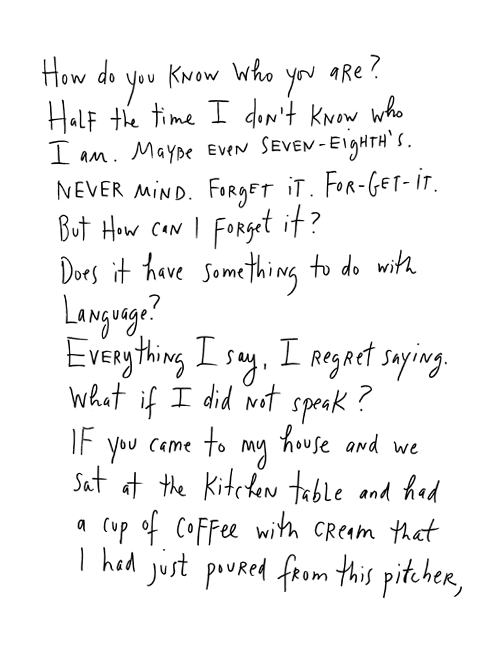
“How do you know who you are?” asks artist and author Maira Kalman in her book, The Principles of Uncertainty. I’ve not read the book, but I’ve been a fan of Kalman’s work since I first saw her blog, “And the Pursuit of Happiness” for the NYT. So when I saw this post about her at Brain Pickings today, I was once again struck by her musings.

It’s something on my mind today, this question, “How do you know who you are?”

Ten years ago today, my mother died. I dread the approach of the 29th of October like nothing else. It’s coming up, I think. Is there any way to get out of it? It’s silly, really. Well, it is silly and not silly all at once. On the one hand, it is only a day. To be blunt: my mother is still dead, every other day of the year. It’s not really any better or worse on this particular date, now is it?

Nonetheless, it is still a day—the day—that, ten years ago, marked the worst day of my life. At one moment, she was here, and the next, she was not.

So every October 29th, at some point—sometimes at multiple moments throughout the day—I feel it all over again. I feel the exact feeling in my stomach that I felt 10 years ago, when I heard a nurse say, “Her heart did stop.” It is a swift kick in the stomach. When it happened this morning, I was rubbing my eyes, convincing myself to shake off my sleepy feeling. And then: BAM. I felt it.

Thanks, October 29th. I’m awake now.

After my mother died, I began thinking of my life in two parts: before Mom died, and after. Things were one way, and then they were another. I also began to think of myself in two ways: how I was before Mom died, and how I was after. It’s really no wonder one day can seem so monumental! I’m thinking of my entire life split in pieces from it.

How do you know who you are, when you are mapping so much of your identity from this loss? I hate it. I want to stop. I think of ways to stop. But it doesn’t really work that way—instead, the elaborate daydreams begin. It’s a little game I play in my brain, where I wonder what my life would be like, what I would be like, if my mother hadn’t died.

It’s a dangerous game, this game of what ifs and if onlys—and I’m tired of it, quite frankly. Of course, it might seem completely self-absorbed that, on the day of my mother’s death, I’m asking all these questions about myself, and not her. But while it’s about me, it’s still about her, all the same.

Of course I am not the same as I was when my mom died, and thank God for that! After all, I was a teenager—18, just starting freshman year of college. Now I am closer to 30 than 20. And so when I think of the question, “Who am I?” it ties into this day so perfectly because on this day, when I particularly miss my mother and feel the utter finality of her absence, I think, I never knew my mother as an adult. She never knew me. And who in the hell am I, anyway?

I don’t always have the answer to that, but I have an idea. Sometimes it changes. Sometimes I like the answer. Sometimes I don’t.

But if my mother taught me anything, it was this very important lesson:

You can be pleased with nothing when you are not pleased with yourself.

So what if I don’t have it all figured out. So what if I can’t always exactly pinpoint the answer to the question, “Who am I?”

Today I am a woman who misses her mother. Tomorrow, I will still be that woman, but it will no longer be this day, and maybe I can think of something else. All I can really try to do is be pleased with the honest answer to the question, “Who in the world am I?” and maybe, just maybe, if I’m pleased with it, it’s not unlikely that she would be too.

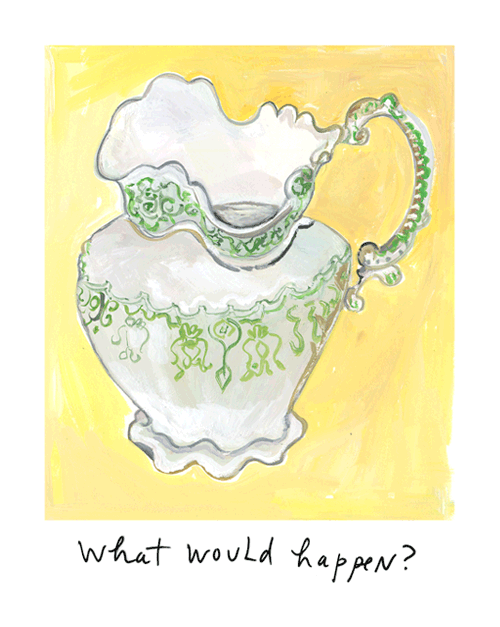
Like Kalman says:


What would happen?

Monday, June 18, 2012

Jewelry Stories

I went through a phase in college where I’d wear as many as eight bracelets on each wrist, usually beaded bracelets that would occasionally, and embarrassingly, fall apart during class, and go spilling across the floor. This was in part because I liked to sit and spin them in circles around my wrist, and partly because they were cheap beaded bracelets that weren’t meant to be tugged at, pulled at, and stretched the way I did.

The only time I managed to leave my bracelets the hell alone was the days I’d wear three of my mom’s beaded bracelets. They were purple and gold, something she’d bought on one of her “sister’s weeks” in Florida, an annual trip where she spent a week with my aunts, and from what I could tell, laughed a lot and told them way more information about me than I wanted anyone to know. These purple beaded bracelets were inexpensive too, but because they were my mother’s, and something I’d taken out of her jewelry box after she died, I treated them with better care than I would have otherwise. I wore them specifically on exam days, and would look down at my wrist whenever I was stuck on a question. I refused to leave my house and go to class until I had them on my right wrist, and the exam days I would forget them, I'd remember as soon as the test started and I'd start cursing myself and be convinced I wouldn't remember anything.

via [etymologie]

This was around the same time I never took off several turquoise rings, also scavenged from Mom’s jewelry box. The one I wore on my pinky was slightly too big, and over the course of college I lost it three times. Each time I was devastated, and reacted so dramatically that it was kind of scary, and absolutely ridiculous. Later, when I'd find it again, at the bottom of my closet, on a friend's floor, or wherever, I'd be giddy and act as if it was a sign: "It always comes back to me!" It was even more dramatic when I reminded myself that it was simply a silly turquoise ring that I had actually never even seen her wear. 

But it wasn’t about that. I had found the turquoise rings in Mom’s jewelry box the day after she died, and put them on my fingers. At the funeral home, when I couldn’t bear to look at my mother, who was no longer my mother at all, I’d look down at my hands and twist the rings. I thought of my mother’s hands, and the way they looked when she would clutch the church pew in front of her when we were singing hymns. And I twisted the rings around my fingers. Over and over again. 

A couple of years ago, for my brother Jay’s wedding, I decided to wear Mom’s wedding ring. I had never worn it before, partly because it was gold and didn’t match my turquoise, and partly because I was terrified of the guilt and grief I might feel, should I ever lose it. I kept looking down at my hands that day and seeing my mom’s hands instead.

I’ve worn the ring almost every day since. When I'm nervous or upset, I twist it around my finger, over and over again.When it's not on my finger I feel naked. I still look at my turquoise rings on my dresser, and enjoy the sight of them. Sometimes I wear them, even though they clash with the wedding ring.

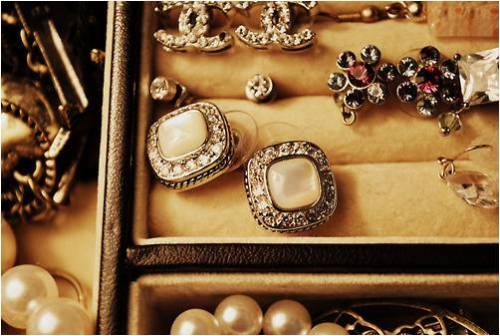
Jewelry, to me, isn’t just an accessory. The jewelry I’m wearing is telling a story. Maybe no one other than me is interested, but I really don’t care. Maybe it’s part of the reason why I tattooed a book on my wrist. There’s a story there, if you care to hear it. I like to think other women feel the same way about the items they choose to put on their fingers, their wrists, or dangling from their ears or around their necks.

Today, I’m wearing my mother’s wedding ring, and a few other stories. On one wrist, a beautiful bracelet that was a birthday gift from my best friend, on the other, a turquoise bracelet that was a gift from my Aunt Linda, and a beaded bracelet I bought myself. Around my neck is a lightning bolt from Marco.

They might not all match. They might not even all make sense, worn together. But together, they piece together the makings of a story, and each one makes me smile for different reasons. Later, they might wait in a jewelry box to tell a story for someone else.

another piece found in Mom's jewelry boxes


Sunday, May 6, 2012

Me and Tess (of the D'Urbervilles): It's Complicated

When I was in high school, my mother kept insisting that I read Tess of the D’Urbervilles by Thomas Hardy.

“You’ll love it!” she said. “It’s one of the classics.”

She directed me to the shelf where I’d find the book. “It’s in the study,” she said. Then she pointed me to its exact location. (My mother knew every book in the entire house’s exact location. It was eerie, because the books really never appeared, to me at least, in any particular order.)

I reluctantly got the book off the shelf.

Afterward, the book sat, neglected, in my room.

“Why don’t you want to read it?” Mom kept asking. She seemed hurt about it.

I never had a good answer. Ultimately, the book, like many of her books, ended up on my shelf. I finally started reading it in college about a year after she had died, but I couldn’t finish it—even though I did like it, just like Mom had insisted. I put it back on the shelf, neglected.

Soon after, during the fall semester of my junior year of college, I was required to read another Thomas Hardy book, The Mayor of Casterbridge, for one of my literature classes. I loved it, just as Mom had said I would love Tess.

Now, Tess of the D’Urbervilles rests on my shelf in Chicago, nestled between my paperback copy of The Mayor of Casterbridge and Wuthering Heights. Until today, it hasn’t come off the shelf since I last moved, two years ago. And before that, I only picked it up to move it to another shelf.

I keep moving the book from place to place. Yet other than always receiving a spot on my crowded bookshelf, it remains neglected. In between books, when I scan my shelves for the next read, sometimes my eyes cross over it, and I feel a little pang. (Why don’t you want to read it? I hear in my head.)

When I picked it up today, I flipped through the pages, wondering if there’d be a bookmark in it from my last failed attempt at reading it. As I suspected, there was—on page 220. 220! I only had 150 pages left to go.

Why didn’t I finish it? I’m sure, back when I was reading it, about nine years ago, I’d have come up with plenty of excuses: I had too much to read already, for class; I didn’t have time; I had lost interest.

But today, when I thought about what book I wanted to read next—I just finished re-reading Pride and Prejudice last night, sigh—I thought about Tess.

I think I’m finally ready.

The thing is, the longer I staunchly refused to read—or finish—the book, the longer I could still be that stubborn teenager, refusing to read the book her mom suggested to her. I’ve been scared to read it, because to read it—ridiculous as it may seem—was to admit that I can’t be that stubborn teenager any longer. To read it was to let go, to move forward. How could I finally read it without being able to call her, to hear her delight when I could say, at last, “Mom, I read Tess! I loved it.”

That phone call cannot happen. It still devastates me. But that is the reality. So really, the only thing to do is simple: Just read the book.

In my mind, she will be reading it with me.

Tuesday, February 28, 2012

Back Off Mama Bear: Why Slate's Rant Against the Berenstain Bears Was More Than Just Untimely

Tonight, I learned that Jan Berenstain, co-creator, writer, and illustrator of the bestselling children's books, the Berenstain Bears, passed away several days ago. Her husband and partner in the series, Stan, died in 2005. Together, the two wrote more than 300 books, which have sold 200 million copies and inspired an animated television series and more than 20 television movies.

Within minutes of reading Ms. Berenstain's obituary, I saw the following headline on Slate's website: Berenstain Bores.


I then made the mistake of reading the article.

First, may I just say: Shame on you, Slate! On the same day the NYT posted Jan Berenstain's obituary, you chose to run an article entitled 'Berenstain Bores'?

This title alone is offensive—because while the author of the piece, Hanna Rosin, and her editor(s), who most likely actually wrote the title, are obviously entitled to believe that the Berenstains', and or their fictional characters, the Berenstain Bears, are boring, the fact of the matter is, the timing of this opinion piece is inappropriate. Not only is it inappropriate, it is downright tacky and disrespectful. The woman just died. She happens to be the co-creator of a beloved children's book series. Tell me, what about her offends you so deeply that a rant about her books seems necessary right now?

Well, let's see, shall we? The article now begins with an update and "apology" from the author:
UPDATE, Feb. 28, 2012: I have been roundly (and deservedly) chastised in e-mails and elsewhere by Slate readers for my use of “good riddance” in connection with this kind woman’s death. I admit, I was not really thinking of her as a person with actual feelings and a family, just an abstraction who happened to write these books. Apologies. Next time I will be more humane. --Hanna

I hadn't even read the article yet, and I found this "apology" utterly ridiculous—"I was not really thinking of her as a person with actual feelings and a family," the apology goes. Um, what did you think, that Jan Berenstain was ACTUALLY a cartoon bear? Of course she was a person with actual feelings! Yes, next time you should be more humane, and your editors should use better judgement as well. Because if they did, this opening would never have been published:
The world today brings news that Jan Berenstain, co-author with her husband Stan of the 45 years and running Berenstain Bears series for children, has passed on to a better world. As any right-thinking mother will agree, good riddance.
Good riddance? Even if by "good riddance," Hanna Rosin was addressing Ms. Berenstain's books, the way these sentences are structured, it reads quite clearly as if she is saying "good riddance" to Berenstain herself. Just read it again if you don't believe me. But, okay: She's talking about the books. Hmm. Are the more than 300 books already published going to magically disappear because both authors are now deceased?

What a revelation! I can't believe this!

DO YOU KNOW WHAT THIS MEANS?!

KURT VONNEGUT IS STILL ALIVE?! SYLVIA PLATH NEVER KILLED HERSELF! [Insert the name of all the countless other deceased authors whose publications are still on bookshelves.]

All right, I'm sorry. I take it back. I'm being a little childish now, aren't I? Maybe I should remember my manners. Oh wait, I have just the book:


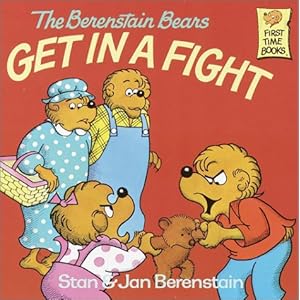
This is just one of many Berenstain Bears books that my mother read to my brother and me when we were growing up. But according to Ms. Rosin, any "right-thinking mother" would agree that this is just awful bedtime reading for kids. Teaching manners at the dinner table, what a bore!

Here are some of the author's issues with the polka-dot wearing matriarch of the bear family, the beloved Mama Bear:
There, in the big treehouse down a sunny dirt road deep in Bear Country is Mama Bear, known only ever as Mama Bear, wearing the same blue polka-dotted muumuu and housecap in every single book, inside the house and on the very rare occasions when she leaves it. (What’s her problem? Is there no Target in Bear Country? Is she too busy to change? Is she clinically depressed?) Mama Bear’s only pleasures in life seem to come from being the Tracy Flick of domesticity, making up charts for good behavior and politeness, encouraging her children to use pretentious British affections such as 'terribly sorry' and 'lovely, my dear.'
Perhaps I might be equally appalled by Mama Bear being only known as such if all the other family members weren't similarly named. Papa Bear. Sister Bear. Brother Bear. But if only Bear Country had a Target, maybe Mama Bear could have had some time to herself to find a name! Berenstains! You fools!

Then there's the matter of her always "wearing the same blue polka-dotted muumuu and housecap in every single book"—so what? I don't recall Papa Bear ever changing out of his overalls, either. Sister Bear wore the pink overalls, Brother Bear wore the red shirt... seriously, what's the issue? Is it because it was a muumuu? Because of the housecap? The polka dots? I mean hell, I don't like polka dots much myself, but yeesh.

Look, I don't want to fight about this.


So let's just get to your real issue with Mama Bear, shall we? It's not just those silly polka dots. The article goes on to say:
I have loved many a midcentury book starring the retrograde housewife. Most great Dr. Seuss books were written around the same time. The Frances books are some of my favorites, and Mother in that book never changes out of her apron. And I can read Richard Scarry all day. But usually you need humor to soften the blow. Stan and Jan, sadly, were allergic to humor. This is the only thing I hold against Theodor Geisel, aka Dr. Seuss. He was the one who apparently approved the Berenstain Bears books and yet he never pushed them to write one funny line. Papa Bear for example, is a bumbling oaf. The usual plotline in the books involves Papa trying to fix some problem but screwing it up, so that Mama has to swoop in and save the day. In defter hands, Papa could have been a prototype Homer Simpson. But in these book he just bangs on the table and shouts things like 'pinheaded fiddlebrain!'
What bothers me most is the implication that Mama Bear isn't a good role model, or is somehow lacking because her "only pleasures in life seem to come from ... making up charts for good behavior and politeness, encouraging her children to use pretentious British affections." Maybe Mama Bear's great pleasures in life do stem from encouraging her children, but I don't think it was ever about "pretentious British affections"—as I remember it, from some of my first memories as a reader, and some of my favorite childhood memories with my mother, Mama Bear taught the cubs:

To clean up after themselves and take care of their belongings. 

To appreciate what they have and to understand the importance of a family budget.


The importance of a healthy diet and exercise. 


Why it's always better to be honest (oh wait, that 'bumbling oaf' Papa Bear stepped up his game and helped teach this lesson!)


I'm not familiar with the particular book that this author is most annoyed by,  The Birds and the Bees and the Berenstain Bears, but whatever. That same mother who read these books to me and helped instill my lifelong love of reading also sat me down and had a frank talk about "the birds and the bees," so I might suggest you simply ditch the children's books for that conversation if you're looking to be candid.

So back off Mama Bear, her polka dots, and the fact that she is a stay-at-home mom. She might "only" be a housewife, but so was my housecoat-wearing Grandma Hamm, and she was a badass. My mother was a teacher, and I think she, along with about 200 million other readers of these books, enjoyed every minute with Mama Bear and the rest of the Bear clan.


Rest in peace, Jan Berenstain.

Tuesday, February 21, 2012

Let’s Split One

When I was growing up, every once in awhile, when we were driving through town, Mom would stop at the gas station, smile and say, “Want to split a candy bar?”


I swear, she’d smile so mischievously, you’d think she’d suggested we split a joint, not a candy bar.

I’d hop out of the car and go grab one for us, our mutual choice almost always a Milky Way Dark. (At some point when I was in high school, Milky Way Dark became Milky Way Midnight, but by this time we weren’t too concerned with splitting candy bars.) When I got back to the car, candy bar in hand, usually I’d just break it in half, study the two halves for a second to make sure they were even, and then hand Mom her share. Sometimes, though, if we were on our way home, we'd wait until we got home, when Mom would cut it with a knife, which I found really entertaining.

“This is what we did when we were girls,” she’d say, looking serious.

At least, this is how my memory tells me this goes. I can never remember if my brother was involved in any of this candy bar splitting, exactly, but my memory stubbornly gives me this image of Mom standing in our kitchen, cutting a candy bar for us to share.


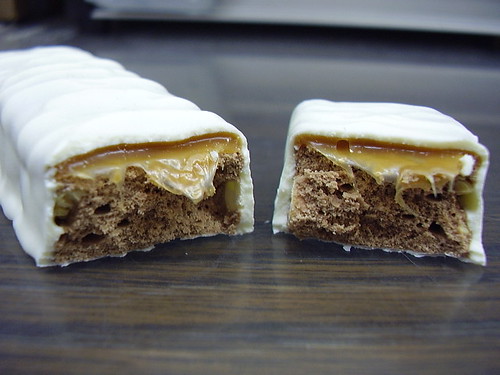
When we weren’t splitting our candy bars, it was still a special treat to stop for a candy bar, but I’d opt for a 3 Musketeers, and Mom, a Zero bar. I used to think her Zero candy bars were disgusting—White chocolate? Almond nougat? Gross—and refused to even try it.

The first time I recall finally trying the Zero bar, I was driving either to or from Bloomington, on one of my weekend trips home. My mother was no longer alive; there was no one in the car with me at all. But when I stopped at the gas station I felt like I had to get one. I got back in my little Neon Sport, and took a bite.

And then I busted out laughing. I loved it! Mom was right! Who would have thought?

The next time I had one, I was really upset about something—what, I don’t remember. But again, I stopped, and bought a Zero. I got back in my car, unwrapped the Zero, and took a bite. I burst into tears and sat there for a minute, just looking at the stupid white candy bar in its silver wrapper as I cried. After I calmed down, I got back on the road, and every so often, would take another bite and sniff.

It’s kind of amazing how long you can make a candy bar last, if you really try.

Milky Way Midnight is still my go-to candy bar, even as an adult. But over the years, if I’ve decided to treat myself to a candy bar—and I say treat not because I’m so stingy with my diet and sweets, but more because that’s how Mom always made me think of candy bars: as a special treat—sometimes I’ll buy a Zero bar. Whenever I do, I’m usually driving somewhere, typically from Chicago to Knightstown, or vice versa.

I eat it slowly, enjoying each bite. When I get halfway through, I put it in the cup holder for a while and ignore it. Maybe it’s totally crazy, but I like to think I’m splitting it with someone.


Poetry Slam Tuesdays: When She Sings

I’ve had this Neko Case song in my head
For hours

Hey when she sings when she sings when she sings like she runs
Moves like she runs


And I’ve been feeling homesick for something that doesn’t exist
For years

Go on, go on scream and cry
You’re miles from where anyone will find you


It’s okay, though, really
Mostly just that I keep wanting
A conversation
That I cannot have

Cause I was once told to write a letter
That cannot be sent

Hey when she moves, when she moves when she moves like she runs

We used to toy with these grandiose ideas
Of things that were gonna happen
(they never did happen)

And it makes me a little sad
I’m more than a little wistful

So I went to the coffee shop
And I bought a mint tea
You weren’t there
Because you’re never any where

Hey there there's such deadly wolves 'round town tonight
Round the town tonight


They gave me my tea
On a little dish
With a tiny spoon
And even cramped at the tiniest table
Leaning over my massive Joan Didion book
It was perfect even if it was not
The other chair would stay empty,
So I propped my foot on it

Oh how I forgot what it’s like

Overwhelmed, I flipped around
Read about migraines and Georgia O’Keefe
Until I couldn’t concentrate any more,
So I pulled out my red journal
And began frantic scribbles of thoughts

Trees break the sidewalk and the sidewalk skins my knees

There’s an empty spot on the wall
Where I knocked the record off
Now there’s only a nail, bare

In my head, I compared it to myself
Then scoffed at my own ridiculousness
Wanting to laugh with him again
About how dramatic I felt
But he wasn’t there either

The look on your face yanks my neck on the chain


Today I tried to picture you
Reading my writing
I was hoping you might smile
Praying you’d be proud

And I would do anything
To see you again


I didn’t have the answer
I haven’t written a letter
I couldn’t cry

So I just held my head high
Against the Chicago wind
My collar flipped up
My boots clacking on the sidewalk

And I smiled,
Even though the wind was cold
Against my face

Because I think that maybe, just maybe
That when I’m alone
I walk fast, head up high,
Just like you did.
Right at that thought,
A stranger passed me and smiled

I knew it’d be okay.

Hey when she sings when she sings when she sings like she runs
Moves like she runs


Sunday, January 29, 2012

Recommended Reading: Mother Loss, and Mindy

In the last couple weeks, I've read two books that were incredibly enjoyable in wildly different ways.

First up: Motherless Daughters, by Hope Edelman

I found this book last week when I was silently geeking out in the new neighborhood used bookstore, Uncharted Books. How could I not geek out?

1) A used bookstore, in the neighborhood.

2) Huge women's studies section (now this is huge, relatively speaking. This is not a big bookstore. We're talking four or five shelves here.)

I'd been hoping I'd find a good book to buy to show my support/ridiculous excitement over the bookstore's arrival to Logan Square, and then, there it was:


This book was an incredibly meaningful read to me, for obvious reasons. (Well, obvious if you know me, and/or you've read this blog before. And of course you know me! You are either my brother or my cat!)

The author, who lost her mother when she was 17, chronicles her own story of losing her mother while also using interviews with hundreds of "mother-loss survivors" of all ages and circumstances of how they lost their mothers. It explores how losing your mother at various ages impacts a woman (or girl, in many cases) in different ways; how a relationship (or lack of) with your father influences a woman's grief, and reality; the loss of a woman's main feminine role model; how mother-loss impacts romantic relationships. And so on. And so on.

Maybe this would be a better summary: I started reading it the following morning on my commute, and got really choked up reading the introduction. 

This is why:

When my mother died, I knew no woman my age who had experienced mother loss. I felt utterly and irrevocably alone. In college, where new friends knew only as much about me as I was willing to reveal, I told few people my mother had died. Besides being unable to mention her death without breaking down, I was frightened by other people's pity. It marked me as someone different, an outsider, an orphan worthy of compassion at a time when I desperately longed for the anonymity of a crowd. In my dormitory, in my sorority, I felt as if I wore a scarlet letter visible only to me, a personal reminder of what felt like a source of shame. The other freshmen I knew had mothers who wrote letters, sent care packages, and called every Sunday at noon. When the women on my floor pulled their telephones into the hallways, I sat crosslegged on my bed and feigned interest in a human origins textbook. In conversation, I became as evasive as a defensive politician, making deliberate references to "my family" rather than "my parents" and carefully constructing sentences that never referred to my mother in the past tense.
I could have written this paragraph about my own experience, practically verbatim. (Eliminating, obviously, the sorority part.) Throughout the book, there were similar moments. This was incredibly comforting and powerful to read, particularly when I read the stories of women who lost their mother between the ages of 17 and 20, because I could relate to them the most. (I was 18, two months into my freshman year at college.)

But also comforting, in a completely different way, was realizing through these stories just how lucky I was, and am. The chapter, "Daddy's Little Girl" was a little painful to get through (in part because I hate that title). The author discusses four different types of fathers. I got through the first three, including the I'm Okay, You're Okay Father, The Helpless Father, and then The Distant Father, and thought, What the hell? None of these reminded of my father at all. But then I got to the fourth one, The Heroic Father. I hate to admit, at first I was a little skeptical. Really? Heroic? Seemed a bit extreme.


But then she goes on to describe this "heroic" father with various examples:

Samantha's father held a full-time job, headed a household, and attended to his five children's emotional and physical needs. He was a 'heroic father,' and his daughter credits him with the security and emotional strength she feels today...After her mother's death when Samantha was fourteen, her father continued and even deepened his relationship with his four daughters and one son when he became their only parent.


The heroic father typically shared child-rearing and household tasks when his wife was present and had warm, loving relationships with his children before their mother died.


The heroic father isn't perfect and is still prone to bouts of depression or doubt, but he's still clearly a parent in control. Despite his own grief, he manages to maintain a safe, supportive environment that absorbs some of the shock of a daughter's loss and helps her continue developing confidence and self-esteem... Unlike daughters of helpless or distant fathers, who must either withdraw some of their dependency or face disappointment, the daughter of a heroic father has a dad she can depend on. Even as an adult, she typically continues to rely on him for emotional support.

Well, then. There you have it. Heroic is right. Sheesh. My dad's awesome.

Okay, so, that book. Feelings! (But seriously, it was incredible.)

Midway through all this reading about mother-loss, and grieving, and relationships, I took a break to read a different book. It was a wee bit of a lighter read:

Lola, my dad & Deb's cat, making her first appearance on the blog. She did not read the book.

I love Mindy Kaling. (You might know her from a little show called "The Office.") I may or may not tweet about her on a semi-regular basis.

I'd read a couple of excerpts from this book already, one published in The New Yorker and the other in Glamour. The rest of the book did not disappoint. In fact, I read it in one sitting. And I LOL'ed throughout. And this introduction was particularly funny:
Thank you for buying this book. Or, if my publisher's research analytics are correct, thank you, Aunts of America, for buying this for your niece you don't know that well but really want to connect with more.
 My Aunt Linda gave me the book. 

Next up, I'm going to either read A Tree Grows in Brooklyn (I think I read it when I was about 14, but I can't remember, yikes) or I'm going to take my second attempt at reading The Golden Notebook.


And considering I've run out of episodes of Luther to watch for the time being, looks like it's back to the books.

Happy reading, fellow nerds!

Sunday, January 15, 2012

Sick Day

When I was little, staying home from school sick typically meant spending the day at Grandma Hamm’s. Mom would drop me off on her way to school, and then it’d be a day at Grandma’s until she’d be back around 4 to bring me home.


I both loved and hated this. Loved, because a sick day at Grandma’s meant I could lay in her bed and read old Nancy Drew novels cover to cover, interrupted only by Grandma checking on me every so often. I hated it for silly reasons that seemed incredibly not silly to my seven-, eight-, or nine-year-old self: Grandma always had Robitussin cough drops in awful flavors, unlike the Luden’s cherry cough drops I preferred, that basically just tasted like candy and did absolutely nothing. I was convinced she’d had the same bag of cough drops for decades, because of the way the paper would stick to the cough drop as if the two things were actually merging together. I’d force myself not to make a face as I unwrapped the cough drop and slowly place it in my mouth, because Grandma would be watching, and as soon as I’d make a face, she’d scoff, “Oh, it’s not that bad” and I’d immediately feel ridiculous and sulk into my book for the next half hour. Nothing, and I mean nothing, was worse than a rebuke from Grandma Hamm. Which was probably why I typically did everything possible to avoid a rebuke at all costs, even when sick. So I’d choke on the cough drop and mind my own business until Mom came to get me after school.

It was understood that if either my brother or me were out of school sick, it was the other one’s responsibility to collect the homework, which was particularly annoying if it required lugging one or more of my brother’s books, in addition to mine, home from school. Most days, we rode the bus, but if one of us had a sick day at Grandma’s, it was more likely that Mom would pick the other one up from school. When the tables were turned, and Jay had been sick at Grandma’s all day, I’d run into Grandma’s, feeling smug that I was the healthy one, knowing Grandma would be excited to see me, unlike Mom, who would often be cranky and “so stressed out” that she didn’t seem to be as delighted by me as I felt was necessary.

But although there was something special, and somewhat sacred, about those sick days at Grandma’s, there was one sick day from my childhood that I’ve always remembered quite vividly, at least in part.

It was my second day in a row having to stay home from school, and I had a fever. For whatever reason, my mom decided to stay home with me that day. I felt miserable, and my whole body, particularly my legs, ached and ached. I was probably whining about it. I mean, who am I kidding—I was most certainly whining about it.

But that day, I wasn't told to quit complaining, or to toughen up. Instead, Mom sat on the couch with me, my legs propped on her lap, and we watched The Sound of Music together.

That’s it: The part of the day I remember vividly. It’s not much, but it’s enough.

As an adult, it’s different. You can’t whine to your mom when your body aches from a fever. Your parents don’t ultimately make the decision about whether or not you go to school (work) when you’re sick, or when it’s the right time to go back. In college, when I first started having to deal with the reality of becoming an adult and taking care of myself, being sick also brought this strange sort of homesickness along with it. It wasn't just that I wanted to go home—I wanted to go back in time, when Mom or Grandma (or both) were still there to take care of me.

I think about mom, and Grandma Hamm, often when I’m sick. At 27, I’m a little too old to be whining and wishing I had a parent or grandparent to take care of me when I’m not feeling well. That’s for sure.

But I guess it’ll never change that every time I’m sick, there’s a little part of me that will always think of, if only for a moment, Nancy Drew and The Sound of Music.