Showing posts with label slate. Show all posts

Tuesday, February 28, 2012

Back Off Mama Bear: Why Slate's Rant Against the Berenstain Bears Was More Than Just Untimely

Tonight, I learned that Jan Berenstain, co-creator, writer, and illustrator of the bestselling children's books, the Berenstain Bears, passed away several days ago. Her husband and partner in the series, Stan, died in 2005. Together, the two wrote more than 300 books, which have sold 200 million copies and inspired an animated television series and more than 20 television movies.

Within minutes of reading Ms. Berenstain's obituary, I saw the following headline on Slate's website: Berenstain Bores.


I then made the mistake of reading the article.

First, may I just say: Shame on you, Slate! On the same day the NYT posted Jan Berenstain's obituary, you chose to run an article entitled 'Berenstain Bores'?

This title alone is offensive—because while the author of the piece, Hanna Rosin, and her editor(s), who most likely actually wrote the title, are obviously entitled to believe that the Berenstains', and or their fictional characters, the Berenstain Bears, are boring, the fact of the matter is, the timing of this opinion piece is inappropriate. Not only is it inappropriate, it is downright tacky and disrespectful. The woman just died. She happens to be the co-creator of a beloved children's book series. Tell me, what about her offends you so deeply that a rant about her books seems necessary right now?

Well, let's see, shall we? The article now begins with an update and "apology" from the author:
UPDATE, Feb. 28, 2012: I have been roundly (and deservedly) chastised in e-mails and elsewhere by Slate readers for my use of “good riddance” in connection with this kind woman’s death. I admit, I was not really thinking of her as a person with actual feelings and a family, just an abstraction who happened to write these books. Apologies. Next time I will be more humane. --Hanna

I hadn't even read the article yet, and I found this "apology" utterly ridiculous—"I was not really thinking of her as a person with actual feelings and a family," the apology goes. Um, what did you think, that Jan Berenstain was ACTUALLY a cartoon bear? Of course she was a person with actual feelings! Yes, next time you should be more humane, and your editors should use better judgement as well. Because if they did, this opening would never have been published:
The world today brings news that Jan Berenstain, co-author with her husband Stan of the 45 years and running Berenstain Bears series for children, has passed on to a better world. As any right-thinking mother will agree, good riddance.
Good riddance? Even if by "good riddance," Hanna Rosin was addressing Ms. Berenstain's books, the way these sentences are structured, it reads quite clearly as if she is saying "good riddance" to Berenstain herself. Just read it again if you don't believe me. But, okay: She's talking about the books. Hmm. Are the more than 300 books already published going to magically disappear because both authors are now deceased?

What a revelation! I can't believe this!

DO YOU KNOW WHAT THIS MEANS?!

KURT VONNEGUT IS STILL ALIVE?! SYLVIA PLATH NEVER KILLED HERSELF! [Insert the name of all the countless other deceased authors whose publications are still on bookshelves.]

All right, I'm sorry. I take it back. I'm being a little childish now, aren't I? Maybe I should remember my manners. Oh wait, I have just the book:


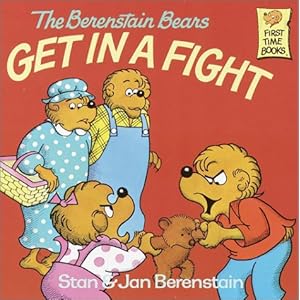
This is just one of many Berenstain Bears books that my mother read to my brother and me when we were growing up. But according to Ms. Rosin, any "right-thinking mother" would agree that this is just awful bedtime reading for kids. Teaching manners at the dinner table, what a bore!

Here are some of the author's issues with the polka-dot wearing matriarch of the bear family, the beloved Mama Bear:
There, in the big treehouse down a sunny dirt road deep in Bear Country is Mama Bear, known only ever as Mama Bear, wearing the same blue polka-dotted muumuu and housecap in every single book, inside the house and on the very rare occasions when she leaves it. (What’s her problem? Is there no Target in Bear Country? Is she too busy to change? Is she clinically depressed?) Mama Bear’s only pleasures in life seem to come from being the Tracy Flick of domesticity, making up charts for good behavior and politeness, encouraging her children to use pretentious British affections such as 'terribly sorry' and 'lovely, my dear.'
Perhaps I might be equally appalled by Mama Bear being only known as such if all the other family members weren't similarly named. Papa Bear. Sister Bear. Brother Bear. But if only Bear Country had a Target, maybe Mama Bear could have had some time to herself to find a name! Berenstains! You fools!

Then there's the matter of her always "wearing the same blue polka-dotted muumuu and housecap in every single book"—so what? I don't recall Papa Bear ever changing out of his overalls, either. Sister Bear wore the pink overalls, Brother Bear wore the red shirt... seriously, what's the issue? Is it because it was a muumuu? Because of the housecap? The polka dots? I mean hell, I don't like polka dots much myself, but yeesh.

Look, I don't want to fight about this.

So let's just get to your real issue with Mama Bear, shall we? It's not just those silly polka dots. The article goes on to say:
I have loved many a midcentury book starring the retrograde housewife. Most great Dr. Seuss books were written around the same time. The Frances books are some of my favorites, and Mother in that book never changes out of her apron. And I can read Richard Scarry all day. But usually you need humor to soften the blow. Stan and Jan, sadly, were allergic to humor. This is the only thing I hold against Theodor Geisel, aka Dr. Seuss. He was the one who apparently approved the Berenstain Bears books and yet he never pushed them to write one funny line. Papa Bear for example, is a bumbling oaf. The usual plotline in the books involves Papa trying to fix some problem but screwing it up, so that Mama has to swoop in and save the day. In defter hands, Papa could have been a prototype Homer Simpson. But in these book he just bangs on the table and shouts things like 'pinheaded fiddlebrain!'
What bothers me most is the implication that Mama Bear isn't a good role model, or is somehow lacking because her "only pleasures in life seem to come from ... making up charts for good behavior and politeness, encouraging her children to use pretentious British affections." Maybe Mama Bear's great pleasures in life do stem from encouraging her children, but I don't think it was ever about "pretentious British affections"—as I remember it, from some of my first memories as a reader, and some of my favorite childhood memories with my mother, Mama Bear taught the cubs:

To clean up after themselves and take care of their belongings. 

To appreciate what they have and to understand the importance of a family budget.


The importance of a healthy diet and exercise. 


Why it's always better to be honest (oh wait, that 'bumbling oaf' Papa Bear stepped up his game and helped teach this lesson!)


I'm not familiar with the particular book that this author is most annoyed by,  The Birds and the Bees and the Berenstain Bears, but whatever. That same mother who read these books to me and helped instill my lifelong love of reading also sat me down and had a frank talk about "the birds and the bees," so I might suggest you simply ditch the children's books for that conversation if you're looking to be candid.

So back off Mama Bear, her polka dots, and the fact that she is a stay-at-home mom. She might "only" be a housewife, but so was my housecoat-wearing Grandma Hamm, and she was a badass. My mother was a teacher, and I think she, along with about 200 million other readers of these books, enjoyed every minute with Mama Bear and the rest of the Bear clan.


Rest in peace, Jan Berenstain.

Friday, March 4, 2011

A Story With No End

This week’s New Yorker features an essay by Meghan O’Rourke. You might remember, way back in the beginnings of this blog—you know, years ago, back in February and March 2009—that I wrote about O’Rourke’s Slate series on grieving, “The Long Goodbye.”

In nine well-written, touching entries, O’Rourke wrote about losing her mother, who had suffered from cancer. When I read them, I felt both comforted and sad. In certain ways, I couldn’t believe it: Someone actually got it. Someone else out there felt all these crazy feelings I’d been dealing with since my mother died from an extended illness in 2002. I couldn’t get enough. I read the entries over and over. I emailed Meghan to tell her how much it meant to me. I blogged about it. I talked about it with my brother.

And I was pissed.

This was what I wanted to do with my grief over losing my mother: I wanted to write it. I wanted to share it with others, in the hopes that other young women whose moms had died long before their time would benefit from my story, and it would help them heal. Everything was going to be kumbaya and feelings and butterflies. I would finally think and feel, this is it! This is why I’ve gone through all this. I’m going to share my story with the world! We’re all going to grieve and cry together! Hooray for feelings!

Something like that, anyway. But seriously, this was my new life ambition, to write this book. I even wrote, way back in March 2009, “I’ll continue to love this series unless she steals my book idea.”

I’ve had my book about my mother planned, plotted, and outlined since 2008. I’ve had the title ready since 2007. It’s my secret goal and plan that I will only tell you about if (a) I really, really like you, or (b) I’m drunk. So, not so secret, I suppose. You know, because I really like everyone. I never drink.

Have I written this book yet? No. Well, yes and no. I outline it, write various essays and blogs that I’d like to include in it at some point, then I decide it’s all crap, and start a new outline. This process could go on for years. It already has gone on for years. Yet even so, when Jay sent me the Amazon link to—surprise, Meghan O’Rourke’s memoir, The Long Goodbye—I was furious. I felt like a failure. (Have we met? I’m dramatic.)

No matter that I thought her writing was great. No matter that I was comforted from reading about her mother, and her personal loss. She had done it! My plan. My goal. She had done it, and I hadn’t. What did I think, that no other young female writer had ever had a mother they loved suffer from a terminal illness? Did I actually think no one else had, or would ever, touch on this topic?

Wednesday, July 8, 2009

The Horrors of Sleep-Away Camp

I'd almost completely blocked out my painful memory of my only sleep-away camp experience until I read this article today. Now I know why I’m most definitely not normal. I did not like camp. In fact, I hated camp so much I made my parents bring me home.

Here’s what I remember from sleep-away camp. My 2nd grade best friend Amber had talked about it the whole school year—how much fun it was, all of her “camp” friends, how I HAD to come with her that summer, blah blah blah. I remember thinking it was going to be the coolest thing ever. Camp sounded AWESOME.

Then I got to camp. From the moment I put my bag on that bottom bunk I wanted to go home.

Amber had failed to mention that camp would involve countless group activities where a terrifying woman with permed black hair—my 7-year-old self was convinced she was the Wicked Witch of the West—would force me to pray in front of kids I’d only known for one day, and yell at me for playing basketball with the boys. (What the hell kind of scary Christian camp was this? Why did my parents allow this to happen? These are my questions now.)

By day three (or was it two?) I’d worked myself into a stomachache so fierce that the Tums the Wicked Witch was trying to force down my throat just wouldn’t cut it: I had to call my mom. I don’t remember this phone call actually happening, but I do remember the Wicked Witch telling me I was homesick and I’d be fine the next day.

The next day? I couldn’t stay in that terrifying place one more minute. I clutched my stomach and cried until she caved. Amber, who was having too much fun with her camp buddies to understand my misery, was unfazed by my announcement that I was leaving.

My final, glorious memory of camp: my parents getting out of the car when they arrived to pick me up.

I ran away from the clutches of the Wicked West and back to safety. I had made it two and a half days. I was a survivor. Amber and I never spoke about camp again.

Now I understand why my friendship with Amber didn’t make it past 6th grade. We were in two different groups: me, who hated camp so much that I made my parents send me home; Amber, who really, really enjoyed camp.

But as it turns out, we’re both fucked:

“People (like myself) who didn't enjoy camp tend to have a problem engaging in organized activities of all kinds. Later in life we often become criminals or sociopaths. The more respectable among us often become journalists. If we're extremely bright or creative (or aspire to be), we may become writers or scholars or artists. The common thread is an outsider mentality. A self-flattering analysis, I know, but such is my privilege as author of this article.

Some people hated camp so much that they made their parents bring them home. These people should not be confused with the outlaws described above. There is nothing outré about not being able to endure summer camp. The come-and-get-me set grow up to be neurotic and needy. These are people who can often be heard on C-SPAN's early-morning call-in program Washington Journal, filibustering from a time zone still blanketed in predawn darkness, until the host says, ‘Please state your question.’
…

Some people really, really enjoy camp. I wish I could tell you that these people grow up to be really, really normal, but they don't. You know who I'm talking about. These are the ones who wept uncontrollably when the papiermâché numbers spelling out 1967 were set ablaze on a little raft that a camp counselor, under cover of darkness, towed stealthily to the middle of Lake Weecheewachee on the evening of the last group sing. These are the people for whom childhood represented the zenith of human existence and everything that followed an anticlimax. The women—they're mostly women—usually end up in abusive relationships with pathologically angry men who eventually abandon them and pay child support erratically, if at all. If the person who really, really enjoyed camp is a man, then he is unlikely ever to develop an intimate relationship and on occasion may be spotted in the back of a police cruiser speeding away from a grade-school playground.”
If only I could have made it those three more days. Then I could put myself in the more respectable category as journalist and writer. If only. I could have been an outlaw. Now I’m just neurotic and needy. Dammit.

Thursday, March 19, 2009

Dreams

Slate’s series on grieving continues to blow me away. Meghan O’Rourke’s newest entry, “Dreaming of the Dead,” is almost eerily on point. What she writes about dreaming of her mother encapsulates many of my personal experiences. I find it incredibly comforting.

Most specifically:
“What surprises me is how comforted I feel when I wake. I am sad that the dream has ended, but it's not the depleted sadness I've felt in the past when I've woken up from a wishful dream. I feel, instead, replete, reassured, like a child who has kicked the covers off her in her sleep on a chilly night and dimly senses as her mother steals into the dark room, pulls them up over her, strokes her hair, and gives her a kiss before leaving.”

I’ll continue to love this series unless she steals my book idea.