Showing posts with label death. Show all posts

Wednesday, June 5, 2013

How Much Was Mine to Keep?

"And I asked myself about the present: how wide it was, how deep it was, how much was mine to keep." ― Kurt Vonnegut

Last week, the editor-in-chief at my job called all of us in for an announcement. As I walked toward the cafeteria with my friend Logan, we joked that this was it. They must be announcing layoffs. I lined up against the wall with a pit in my stomach as I looked at the managers, and waited for them to start talking. I told myself I was being negative, but from the looks on everyone’s faces, I knew it had to be grim.

What we learned that morning was far worse than that. My coworker, 26-year-old Bobby Cann, had been killed the previous evening riding his bicycle home from work. As others cried—some quietly, some loudly and openly—I felt like I was folding into myself as I bit the inside of my cheek and forced myself not to do the same. As we all walked out of the cafeteria, the collective stunned silence was unbearable. People who had walked in late had bewildered looks on their faces. “What is it?” they asked.

I tried to answer, but could barely get the words out, the tears coming as soon as I spoke.

"Were you close with him?" someone asked, and I shook my head no.

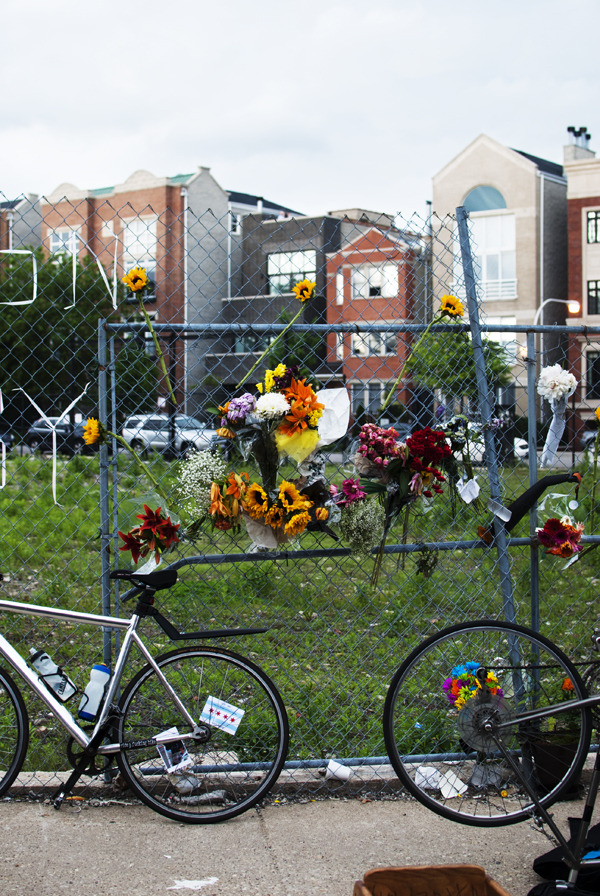
[Memorial for Bobby, via here]

When I got back to my desk I felt sick. Someone—an oblivious coworker, I could only hope—was laughing. Everything just kept going on. But yet it didn’t. Everything felt off.

Meetings were canceled. Emails were sent. But there were still things to write, things to do. We all just kept going on.

Finally, work was over for the day. I got on the bus, surrounded by so many others, just trying to get home from work like I was. Just like Bobby had been the evening before. I felt deeply sad. Because I did not know Bobby well—no more than smiling at him as we passed each other in the hallway, or making small talk in the office kitchen—I doubted my own feelings. Why did I feel so angry? So sad? So sick about the whole thing?

As soon as I got home, I flopped on my bed and stared at the ceiling. I stared at the ceiling until I couldn’t bear it any longer, and then I grabbed my yoga mat and unrolled it. To be able to concentrate on breathing, exhales and inhales, felt like such a gift. Once it was over, I laid motionless on the mat, sweating and breathing heavily. I didn’t realize I had been crying until I stood up, several minutes later.

Finally, I allowed myself to feel all of the emotions of the day. A young man had been killed by a drunk driver, and it was tragic. I might not have known him well, but many did. So I felt sorrow for his family and friends. I felt pissed off at the drunk driver, another person close to my age who, with one horribly stupid and selfish mistake, had stolen a life and in turn ruined his own.

I felt glad to be alive. I felt selfish at the thought. I felt.

I felt.

In honor and memory of Bobby Cann, Groupon is running a campaign with Active Transportation Alliance to raise funds for more protected bike lanes in the city.

Monday, October 29, 2012

How Do You Know Who You Are?

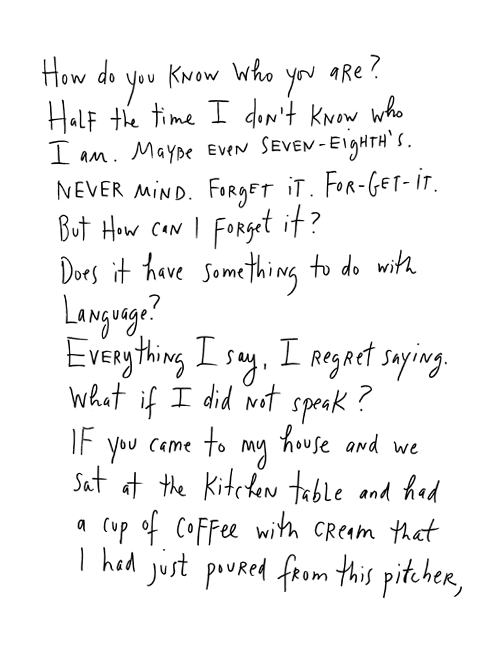
“How do you know who you are?” asks artist and author Maira Kalman in her book, The Principles of Uncertainty. I’ve not read the book, but I’ve been a fan of Kalman’s work since I first saw her blog, “And the Pursuit of Happiness” for the NYT. So when I saw this post about her at Brain Pickings today, I was once again struck by her musings.

It’s something on my mind today, this question, “How do you know who you are?”

Ten years ago today, my mother died. I dread the approach of the 29th of October like nothing else. It’s coming up, I think. Is there any way to get out of it? It’s silly, really. Well, it is silly and not silly all at once. On the one hand, it is only a day. To be blunt: my mother is still dead, every other day of the year. It’s not really any better or worse on this particular date, now is it?

Nonetheless, it is still a day—the day—that, ten years ago, marked the worst day of my life. At one moment, she was here, and the next, she was not.

So every October 29th, at some point—sometimes at multiple moments throughout the day—I feel it all over again. I feel the exact feeling in my stomach that I felt 10 years ago, when I heard a nurse say, “Her heart did stop.” It is a swift kick in the stomach. When it happened this morning, I was rubbing my eyes, convincing myself to shake off my sleepy feeling. And then: BAM. I felt it.

Thanks, October 29th. I’m awake now.

After my mother died, I began thinking of my life in two parts: before Mom died, and after. Things were one way, and then they were another. I also began to think of myself in two ways: how I was before Mom died, and how I was after. It’s really no wonder one day can seem so monumental! I’m thinking of my entire life split in pieces from it.

How do you know who you are, when you are mapping so much of your identity from this loss? I hate it. I want to stop. I think of ways to stop. But it doesn’t really work that way—instead, the elaborate daydreams begin. It’s a little game I play in my brain, where I wonder what my life would be like, what I would be like, if my mother hadn’t died.

It’s a dangerous game, this game of what ifs and if onlys—and I’m tired of it, quite frankly. Of course, it might seem completely self-absorbed that, on the day of my mother’s death, I’m asking all these questions about myself, and not her. But while it’s about me, it’s still about her, all the same.

Of course I am not the same as I was when my mom died, and thank God for that! After all, I was a teenager—18, just starting freshman year of college. Now I am closer to 30 than 20. And so when I think of the question, “Who am I?” it ties into this day so perfectly because on this day, when I particularly miss my mother and feel the utter finality of her absence, I think, I never knew my mother as an adult. She never knew me. And who in the hell am I, anyway?

I don’t always have the answer to that, but I have an idea. Sometimes it changes. Sometimes I like the answer. Sometimes I don’t.

But if my mother taught me anything, it was this very important lesson:

You can be pleased with nothing when you are not pleased with yourself.

So what if I don’t have it all figured out. So what if I can’t always exactly pinpoint the answer to the question, “Who am I?”

Today I am a woman who misses her mother. Tomorrow, I will still be that woman, but it will no longer be this day, and maybe I can think of something else. All I can really try to do is be pleased with the honest answer to the question, “Who in the world am I?” and maybe, just maybe, if I’m pleased with it, it’s not unlikely that she would be too.

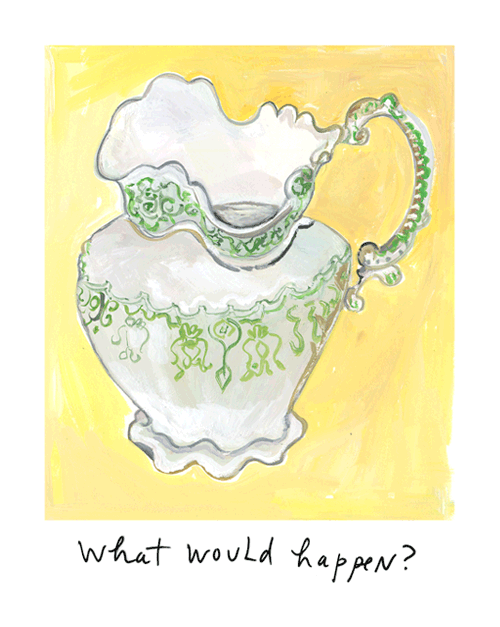
Like Kalman says:


What would happen?

Tuesday, February 28, 2012

Back Off Mama Bear: Why Slate's Rant Against the Berenstain Bears Was More Than Just Untimely

Tonight, I learned that Jan Berenstain, co-creator, writer, and illustrator of the bestselling children's books, the Berenstain Bears, passed away several days ago. Her husband and partner in the series, Stan, died in 2005. Together, the two wrote more than 300 books, which have sold 200 million copies and inspired an animated television series and more than 20 television movies.

Within minutes of reading Ms. Berenstain's obituary, I saw the following headline on Slate's website: Berenstain Bores.


I then made the mistake of reading the article.

First, may I just say: Shame on you, Slate! On the same day the NYT posted Jan Berenstain's obituary, you chose to run an article entitled 'Berenstain Bores'?

This title alone is offensive—because while the author of the piece, Hanna Rosin, and her editor(s), who most likely actually wrote the title, are obviously entitled to believe that the Berenstains', and or their fictional characters, the Berenstain Bears, are boring, the fact of the matter is, the timing of this opinion piece is inappropriate. Not only is it inappropriate, it is downright tacky and disrespectful. The woman just died. She happens to be the co-creator of a beloved children's book series. Tell me, what about her offends you so deeply that a rant about her books seems necessary right now?

Well, let's see, shall we? The article now begins with an update and "apology" from the author:
UPDATE, Feb. 28, 2012: I have been roundly (and deservedly) chastised in e-mails and elsewhere by Slate readers for my use of “good riddance” in connection with this kind woman’s death. I admit, I was not really thinking of her as a person with actual feelings and a family, just an abstraction who happened to write these books. Apologies. Next time I will be more humane. --Hanna

I hadn't even read the article yet, and I found this "apology" utterly ridiculous—"I was not really thinking of her as a person with actual feelings and a family," the apology goes. Um, what did you think, that Jan Berenstain was ACTUALLY a cartoon bear? Of course she was a person with actual feelings! Yes, next time you should be more humane, and your editors should use better judgement as well. Because if they did, this opening would never have been published:
The world today brings news that Jan Berenstain, co-author with her husband Stan of the 45 years and running Berenstain Bears series for children, has passed on to a better world. As any right-thinking mother will agree, good riddance.
Good riddance? Even if by "good riddance," Hanna Rosin was addressing Ms. Berenstain's books, the way these sentences are structured, it reads quite clearly as if she is saying "good riddance" to Berenstain herself. Just read it again if you don't believe me. But, okay: She's talking about the books. Hmm. Are the more than 300 books already published going to magically disappear because both authors are now deceased?

What a revelation! I can't believe this!

DO YOU KNOW WHAT THIS MEANS?!

KURT VONNEGUT IS STILL ALIVE?! SYLVIA PLATH NEVER KILLED HERSELF! [Insert the name of all the countless other deceased authors whose publications are still on bookshelves.]

All right, I'm sorry. I take it back. I'm being a little childish now, aren't I? Maybe I should remember my manners. Oh wait, I have just the book:


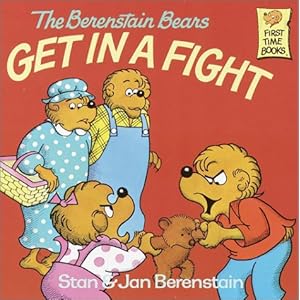
This is just one of many Berenstain Bears books that my mother read to my brother and me when we were growing up. But according to Ms. Rosin, any "right-thinking mother" would agree that this is just awful bedtime reading for kids. Teaching manners at the dinner table, what a bore!

Here are some of the author's issues with the polka-dot wearing matriarch of the bear family, the beloved Mama Bear:
There, in the big treehouse down a sunny dirt road deep in Bear Country is Mama Bear, known only ever as Mama Bear, wearing the same blue polka-dotted muumuu and housecap in every single book, inside the house and on the very rare occasions when she leaves it. (What’s her problem? Is there no Target in Bear Country? Is she too busy to change? Is she clinically depressed?) Mama Bear’s only pleasures in life seem to come from being the Tracy Flick of domesticity, making up charts for good behavior and politeness, encouraging her children to use pretentious British affections such as 'terribly sorry' and 'lovely, my dear.'
Perhaps I might be equally appalled by Mama Bear being only known as such if all the other family members weren't similarly named. Papa Bear. Sister Bear. Brother Bear. But if only Bear Country had a Target, maybe Mama Bear could have had some time to herself to find a name! Berenstains! You fools!

Then there's the matter of her always "wearing the same blue polka-dotted muumuu and housecap in every single book"—so what? I don't recall Papa Bear ever changing out of his overalls, either. Sister Bear wore the pink overalls, Brother Bear wore the red shirt... seriously, what's the issue? Is it because it was a muumuu? Because of the housecap? The polka dots? I mean hell, I don't like polka dots much myself, but yeesh.

Look, I don't want to fight about this.


So let's just get to your real issue with Mama Bear, shall we? It's not just those silly polka dots. The article goes on to say:
I have loved many a midcentury book starring the retrograde housewife. Most great Dr. Seuss books were written around the same time. The Frances books are some of my favorites, and Mother in that book never changes out of her apron. And I can read Richard Scarry all day. But usually you need humor to soften the blow. Stan and Jan, sadly, were allergic to humor. This is the only thing I hold against Theodor Geisel, aka Dr. Seuss. He was the one who apparently approved the Berenstain Bears books and yet he never pushed them to write one funny line. Papa Bear for example, is a bumbling oaf. The usual plotline in the books involves Papa trying to fix some problem but screwing it up, so that Mama has to swoop in and save the day. In defter hands, Papa could have been a prototype Homer Simpson. But in these book he just bangs on the table and shouts things like 'pinheaded fiddlebrain!'
What bothers me most is the implication that Mama Bear isn't a good role model, or is somehow lacking because her "only pleasures in life seem to come from ... making up charts for good behavior and politeness, encouraging her children to use pretentious British affections." Maybe Mama Bear's great pleasures in life do stem from encouraging her children, but I don't think it was ever about "pretentious British affections"—as I remember it, from some of my first memories as a reader, and some of my favorite childhood memories with my mother, Mama Bear taught the cubs:

To clean up after themselves and take care of their belongings. 

To appreciate what they have and to understand the importance of a family budget.


The importance of a healthy diet and exercise. 


Why it's always better to be honest (oh wait, that 'bumbling oaf' Papa Bear stepped up his game and helped teach this lesson!)


I'm not familiar with the particular book that this author is most annoyed by,  The Birds and the Bees and the Berenstain Bears, but whatever. That same mother who read these books to me and helped instill my lifelong love of reading also sat me down and had a frank talk about "the birds and the bees," so I might suggest you simply ditch the children's books for that conversation if you're looking to be candid.

So back off Mama Bear, her polka dots, and the fact that she is a stay-at-home mom. She might "only" be a housewife, but so was my housecoat-wearing Grandma Hamm, and she was a badass. My mother was a teacher, and I think she, along with about 200 million other readers of these books, enjoyed every minute with Mama Bear and the rest of the Bear clan.


Rest in peace, Jan Berenstain.

Wednesday, August 17, 2011

Only In Dreams: Facing Harsh Realities

Dreams present to us parts of reality and of the psyche that we often overlook or don’t wish to see. They are concerned with the growth of the soul. The word for “dream” in Hebrew — chalom — is derived from the verb meaning “to be made healthy or strong.” Dreams tell us that we live up to a mere fraction of our potential and that there are great treasures to be found in the unknown portion of our being. If we heed our dreams, they can help us develop new attitudes toward ourselves and others. They can deepen our spiritual impulses, expand our emotional lives, and produce all manner of changes in our careers and relationships. Marc Ian Barasch, from an interview with The Sun

I wonder about this, the notion that dreams present aspects “of the psyche that we often overlook or don’t wish to see” — because not only do I find that this is often true, I find that my dreams present these things, whether mundane or serious, through exactly the messenger I’ve been dying to see and communicate with for all of my adult life.

My mother.

She’s been talking to me, via my dreams, on a regular basis since she died almost nine years ago. As I’ve written about before, these dreams are not always pleasant. In fact, for many months right after her death, the dreams were flat out nightmares. Night after night, I’d step into a room to face my mother, who had turned into a demonic presence with oxygen cords wrapped around her. And in one way or the other, this demonic presence who was and was not my mother would gleefully tell me that my mother was dead.

If I were telling a story, this might be the part where I’d wake up in a cold sweat, with a loud gasp. But in truth, I’d just slowly, painfully open my eyes, and stare at the bright blue sheets on the bunk bed of my college dorm room — the same sheets my mother and I had picked out together not more than two months earlier — and I’d feel a sharp, painful stab in my chest. Instead of having that moment where you wake up and think with a sigh of relief, “It was only a dream,” I’d wake up and be forced to remind myself, “That was not just a dream.” She was really gone.

I’d slide off the bed and begin the reality of my day.

It wasn’t fun. It was grief. The first inklings of accepting my loss wanted to attack me through my subconscious, it seemed. But even those nightmares, while unpleasant, heartbreaking, and downright terrifying at times, reminded me of the harsh reality I had to face:

My mother was gone, and she wasn’t going to reappear when I woke up. She was dead.

Because my heartbroken, panic-stricken 18-year-old-self did not want to face my new reality, I tried to escape these dreams. During the week, I’d read my books for my African American lit course until my eyes burned and I knew I could fall asleep as soon as I turned off the reading lamp. And every weekend, though perhaps not consciously, I would turn off the dreams in a different way — by shutting off my emotions with a quiet, but clear “Fuck you” through booze, ensuring that by the time my head hit a pillow, if I had any dreams that night, I wouldn’t recall them.

The dreams were persistent, though. Some nights we’d argue: I’d yell at her to take off her oxygen mask, because she didn’t need it anymore. She’d refuse. Other nights, I’d recite French presentations to her and she’d smile at me, tapping her feet as if I were singing, with the stupid oxygen tank tucked neatly under her knees, just as she’d put it when we were in the car together.

My favorite nights, she’d comfort me. Both hands placed on my cheeks, she’d look at me and say:

I didn’t leave you. Don’t cry. I didn’t leave you.

When I’d wake up, the bright blue sheets tangled around my legs, I’d initially feel comforted by the soft, cool fabric. But then I would remember. I’d kick the sheets off that now felt like sandpaper and stare at the white concrete walls of my dorm room, feeling angrier and more alone than ever.

I can’t remember when the nightly dreams stopped. Instead, it slowly transitioned to semi-frequent dreams, or what I now like to think of as visits, from my mother. At first it felt like torture, like every night she came back to life and then died all over again in the morning.
Of course, that was just my mind playing tricks on me. These days, I thrive on the dreams in which my mother makes an appearance. It’s like she’s acting in a brief, but much anticipated cameo role in my life. I love the new discovery I made through reading this interview — that chalom, the word for dream in Hebrew, is derived from the verb meaning “to be made healthy or strong” — because seeing her in dreams reminds me of my inner strength. So even if it’s not really her, exactly, in my dreams, it doesn’t matter.

Sometimes, we still argue, but I think that’s important. Because who better than your mother to remind you that you need to live up to your full potential, to develop new attitudes, and to expand your emotional life?

That’s exactly what she did for me when she was alive. So why not now?

Saturday, September 4, 2010

One Last Song ("I'm Too Young to Feel This Old")

A friend of mine has died.

When I got the news yesterday, I was getting ready for The Black Keys/Kings of Leon concert, running a little behind because I was looking up Black Keys’ videos on YouTube. Right as I found the ideal one to post on my Facebook profile, my friend Natalie messaged me on Facebook, asking if I’d heard the news about Nicole.

I had not. Of course, this now meant she was forced to tell me the news, whatever it was, via Facebook chat.

All I could do was stare at my computer screen and think how absurd the whole thing was. Here I was, about to post a video and some stupid comment about wearing a Goonies shirt and going to the show, and this girl, Nikki, my friend, my former co-worker, was dead.

I couldn’t believe it.

I had to leave for Indianapolis. I had to fix my hair. What was there to do? Believe it or not, I couldn’t cry. So I walked away from my MacBook and tried to get ready, but I couldn’t do that, either. I wrapped a scarf around my head, and that made me feel better for a second. I texted my friend Lauren. I talked to my friend Rachel. Suddenly it all seemed real.

On the drive to Indianapolis, I blared The Black Keys and wondered why I didn’t feel like crying. But my arms were covered in goose bumps and I kept alternating between sweating and having cold chills. I rolled the windows down. I rolled the windows up. I turned up the volume.

I thought about Nikki. I hadn’t seen her in months, not since before I moved back home. We weren’t close friends. We weren’t even the kind of friends who texted or met up for coffee or anything like that. The last time I had actually hung out with her was months and months ago, when a group of girls from work all went out together.

I remember that night, a few of us stayed out later and went to another bar. We’d had too much to drink, but it was one of those nights when you don’t want the fun to end. So you stay out, even when you probably shouldn’t.

Nikki sat next to me at the bar. Out of nowhere, she kind of spilled her guts to me about something. I remember feeling a little shocked that she was telling me all this—these things, these feelings that were clearly weighing heavy on her at the time. Because, like I said, we weren’t particularly close. Mostly, we just chatted while at work together, and when I’d get off of work and ask for a beer, she’d always wink at me and say, “Stella, right?”

Thursday, September 10, 2009

Because I remember when I was you.

A conversation I overheard this past Saturday keeps popping up in my head. I thought about it while I was driving back to Chicago Monday afternoon. I thought about it while I was putting on my makeup the other day. I thought about it while I was waiting on a table last night. It just keeps popping in my head, uninvited, at random moments. I don’t really know why. Maybe it’s because it has nothing and everything to do with me.

I was out to lunch in Indy with my brother and his girlfriend. The restaurant was crowded, and the table behind us was a group of loud, giggly young women. My guess is they were freshman or sophomores at Butler—they all had that excited, freshly realized air of independence about them. From my seat, I was facing their table. While we were waiting on our food for what seemed like forever, I was getting increasingly cranky—a combination of being so hungry I was about to start chewing on the tablecloth, and the table of loud women. If one of them giggled one more time, I was going to throw a bottle of hot sauce at them. Basically, I was hungry. (If I’m this cantankerous at 25, can you imagine what I’ll be like at 65? Yeesh.)

Anyway, once our food arrived, I pretty much forgot about them, until I overheard one girl talking to the now silent group. She was talking about someone going through chemotherapy and how it had been really tough so far. “But the good thing is, she hasn’t gotten any mouth sores yet,” she said. By this point, I had realized this girl was talking about her mother. My sandwich, which had been absolutely delicious until I heard that statement, became tasteless. In that one statement, I heard how scared she was, and how much she needed her mom to be okay. I looked up, and the girl who’d been talking was directly across from me.

Tuesday, February 24, 2009

The Long Goodbye

Slate is doing a series on grieving, and the first two posts by Meghan O’Rourke are frank and well written. It really hit home with me for obvious reasons, but whether you’re “in the club” or not—and I hope that you’re not—it’s a worthwhile read.

It reminded me of this selection from Inventing Memory, by Erica Jong:

“I never thought my mama would die. She seemed immortal to me. Since she was the ground of my being, her death seemed unthinkable—however much she annoyed me at times. Now I am standing at the edge of the cliff with no one to catch me. I’m sure all daughters feel this way when their mothers die.”