Showing posts with label grief. Show all posts

Monday, May 12, 2014

'Like a Last Rain' on Mother's Day

“And what about those who don’t have a mother?” “The Unmothered,” by Ruth Margalit, The New Yorker, May 9, 2014

Last week an acquaintance of mine asked if I was celebrating Mother’s Day. I was caught off-guard. We were on the bus, and had been making small talk prior to this question; I hadn’t eaten any breakfast that morning; and I was not at all prepared to be reminded that one of my least favorite days of the year was on the horizon.

“No,” I said flatly. He looked away for a moment. I decided to be a normal human being and try again. I asked, brightly, “What about you? Does your mother live nearby?”

I knew it was safe to ask about his mother, because his upbeat and unassuming way of asking about the holiday made it clear he had a mother around to celebrate. I was right, of course. He told me about his lovely plans with his family and I continued to smile, wondering if it was at all obvious that inside, I was screaming.

The conversation moved on, as conversations do, and soon enough I got off the bus and walked toward my office, feeling more annoyed with myself than anything else. Sooner or later, I tell myself, I’ll handle these types of questions with grace. And maybe I almost did, this time. I’m not really sure. But what was my alternative? Drop the “No, my mom is dead” bomb in the middle of the 66 bus at 9 a.m.? No thank you. I guess I’ll just sound like a jerk.

With each passing Mother’s Day that Mother’s Day continues to, somehow, exist in this world without my mother alive, I convince myself that this year, I won’t have these moments. I won’t have the conversation I manage to have every year, where some perfectly nice, clueless person who still has a mother and doesn’t really know me asks about my Mother’s Day plans. (I wrote about this dilemma on this very blog four years ago, actually.)

All of this is to say that I’m fine. No, really, I’m fine.


“Trust me, I’m too aware of the fact that my mother is gone to wish her here in any serious way on Mother’s Day. But does the holiday have to be in May, when the lilacs are in full bloom? When a gentle breeze stirs—the kind of breeze that reminds me of days when she would recline on a deck chair on our Jerusalem porch, head tilted back, urging me to ‘sit a while’?”


Mother’s Day often has a way of making me feel very alone in this world. That, of course, is insane. Over the course of the day, I got thoughtful texts and messages from different women in my life who are the proof that I am far from alone: my aunt Deborah; my cousin Micaela; my sister-in-law Tina; my friends Lauren and Natalie. But to not have my mother here on this Earth is to feel a specific sort of aloneness, something that, in spite of all the messages in the world, can never be replaced. This reality used to—and sometimes, on low days, still will—fill me with despair.

That feeling began to threaten me yesterday, if only for a brief moment. I started to feel the sadness take over. I made coffee and didn’t drink any of it. Everything had been fine, but then it was not fine. I sat down at my computer and found this article that I keep quoting here. I thought it would make me feel better, and it would have had I let it, but after I read it I just felt vaguely sick, nauseous. I went outside to my back porch and sat directly in the sun, my bare legs prickling from the heat for the first time in a year. I looked up and squinted into the sun.

I knew what I needed to do. I went back inside to get my phone so I could call my dad. I saw that he had already beat me to the punch, with a short text that said nothing and everything: “hey al hope you’re having a good weekend.”

I went back to my piece of sunshine and called him. The feeling that had threatened to turn this day into a nightmare faded. He is still here. It’s okay. It really is.

The sun was hot on my face. I was not alone.


"What is the death of a loved one if not an oxymoron? My mother isn’t here, and yet I see her everywhere. I kept on looking for hints of her on the page, as though by retracing her beloved books and poems I would get to reclaim a part of her that was already slipping away."


Later in the afternoon the weather shifted from warm sunshine to a cool thunderstorm. When the weather turned, I curled up with my cat Layla next to the open window, the blinds flapping gently from the breeze. I found a movie that I knew Mom and I had watched together, more than once—Sense and Sensibility.

Mom was not there.

Or was she? Next to my television, the framed photo of the two of us at my high school graduation stared back at me. In it, our cheeks are pressed together; our smiles are big. We look just alike. I remember, that spring, counting down the days until I would graduate. If only she can stay healthy to see me graduate, I would think. We made it to graduation. She made it even through that long, hot summer, to come move me in my college dorm. But that would be it. There would be no more landmark moments after that. No more. We’re done.

These thoughts are exhausting. These are the thoughts that take over on Mother's Day. I stared at our photo, not even paying attention to the movie, and I remember posing for it. I remember the feeling of my mother’s warm cheek against mine. I tell myself I remember.

Emma Thompson and Kate Winslet were still talking about something or other on my television screen. I stopped thinking and staring altogether and fell asleep, my fat cat’s paw resting in my hand.

When I woke up from my nap, the feelings were gone. The rain had stopped. The day was once again, just another day.

And I will miss my mom again tomorrow. And then again the next day. And all the days after. But it doesn’t have to be a Day. It just is. We keep on living.


“There’s a word in Hebrew—malkosh—that means 'last rain.' It’s a word that only means something in places like Israel, where there’s a clear distinction between winter and the long, dry stretch of summer. It’s a word, too, that can only be applied in retrospect. When it’s raining, you have no way of knowing that the falling drops would be the last ones of the year. But then time goes by, the clouds clear, and you realize that that rain shower was the one. Having a mother—being mothered—is similar, in a way. It’s a term that I only fully grasp now, with the thirst of hindsight: who she was, who I was for her, what she has equipped me with.

Like a last rain, my mother left behind an earthy scent that lingered long after she was gone.

Like a last rain, for a fleeting moment, everything she touched seemed to glow.”

Wednesday, December 11, 2013

Tis the Season

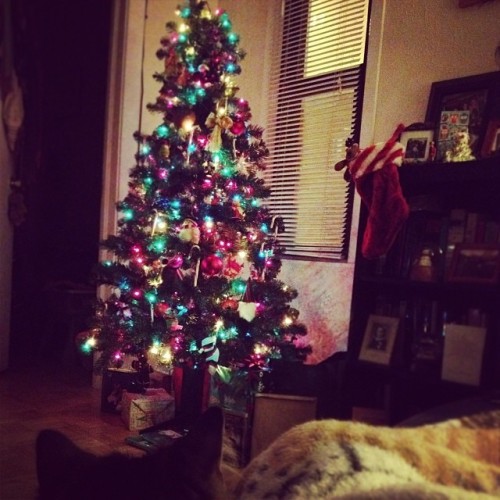
I am really getting in the Christmas spirit this year. Maybe it’s my new Christmas tree. Maybe it’s because my annual reading of Holidays on Ice had me laughing my ass off on the train to myself even more than usual. Maybe it’s my “Let It Snow” Spotify playlist. Maybe it’s from watching Christmas Vacation on a twice-weekly basis and texting quotes to my cousins nonstop.

Whatever it is, I’m going with it.

Yesterday I read this article, “The sentimental, cynical, undying charm of A Christmas Story,” in which the writer makes a lot of wonderful points, not just about that movie, but about the holidays in general. She writes:

"But what happens after that perfect Christmas, when you get the ultimate shiny, exciting thing you asked for, then realize it can’t get better than this? A Christmas Story doesn’t say, but we adults know what happens: The wanting of mere things starts to lose its glittery seasonal appeal. The magic of childhood yuletide fades, and eventually morphs into something else.

There’s a moment in the season-two Christmas episode of The Wonder Years—a TV series that does a much more sentimental version of the narrated-flashback trick from A Christmas Story—when narrator Kevin Arnold describes that transformation as one where the holiday stops “being about tinsel and wrapping paper” and starts “being about memory.” If you believe that’s what happens to Christmas when we grow up, then it makes total sense that narrator Ralphie looks back on the Christmas Story December with such wry wistfulness. It’s because very soon after, possibly the following year, Christmas turned into a time for him to look back, instead of looking forward.

The warm, achingly bright glow of nostalgia is what makes Christmas such an emotional holiday, and it’s also what draws some people to A Christmas Story."

First off, anyone who references The Wonder Years in an article about anything knows exactly what she’s talking about, in my humble opinion. But it’s the part about “the warm, achingly bright glow of nostalgia” that I think is so on point.

My childhood was packed with special Christmas memories. Going to my grandparent’s house on Christmas Eve, with our “Christmas Classics” or “A Very Special Christmas” tapes blaring in the station wagon (later, the Taurus). My brother and I would sing along to Jim Nabors’ “Go Tell It On the Mountain” and Run DMC’s “Christmas Is,” laughing hysterically to ourselves. While at my grandparent’s, we’d all help decorate their tree, one with those absurdly enormous multicolor bulbs and silver tinsel that got everywhere. My grandma would always let me set up the nativity scene on the windowsill, something that filled my child heart with joy and pride. On the way home, we’d usually give my great-grandma, Nannie, a ride home, and Mom would sit in the backseat next to me, a blanket over us as I rested my head on her shoulder and we looked out the car window in awe at all the Christmas lights on the houses.

On Christmas morning, my brother would run to my room to wake me up at an ungodly early hour, where we’d immediately run to the living room and squeal over our newly-filled stockings and presents under the tree. Then we’d run to our parent’s room, where we’d immediately get shot down about them getting up at 5 a.m. to open presents.

So we’d put on the shortest Christmas movie imaginable—typically, How The Grinch Stole Christmas (what is that, like 35 minutes long?)—and then run back again to wake them up. By this point, they’d usually cave, and as they made their coffee, we’d start passing out the presents. Stockings came first, followed by the presents. I always got to start the rotation of unwrapping, because I was the youngest.

Usually after all the presents were unwrapped, you’d find me in the recliner, already reading one of my new books while surrounded by wrapping paper. Next would be a Christmas breakfast, also marking the moment when Dad would inevitably try to play his Three Tenors Christmas album or Mom would try for Gloria Estefan. Afterward, we’d spend the day with my dad’s side of the family, which included two of my favorite Christmas memories with my Grandma Hamm—the year she gave me sugar cookie dough as a gift, and then the infamous year when she gave my younger cousin Claire peanut butter, which Claire promptly started eating with her fingers in the middle of the room, much to the aggravation of my Aunt Linda and the delight of me.

The point is: I was one lucky kid. I don’t have any sad or bad memories of the holidays, just ones like these. The last year my mother was alive, I was 17, a senior in high school. She almost died of a blood infection just a week before Christmas, but by Christmas Day, she was back home, feeling better—or at least putting on a hell of a show for all of us. I actually got sick that year, coming down with a fever on Christmas Eve, and I unwrapped those final presents with my mom in the room with a cold washcloth on my forehead, burning up with fever. But it didn’t matter: she was there. We were all together. It was a gift.


The holidays were the hardest after she was gone. They’re still hard. But we’ve had a lot of time for new traditions, and new family members to celebrate with, like my dad’s girlfriend, Debbie, who insisted I needed a Christmas tree for my apartment and knew just how much I would love to have some of my mom’s old ornaments. We have my one-year-old niece Polly, who could make even the coldest Grinch smile when she winks one of her gorgeous brown eyes, one of her new tricks. (I can only assume she'll be reading Dickens by her 3rd Christmas.)

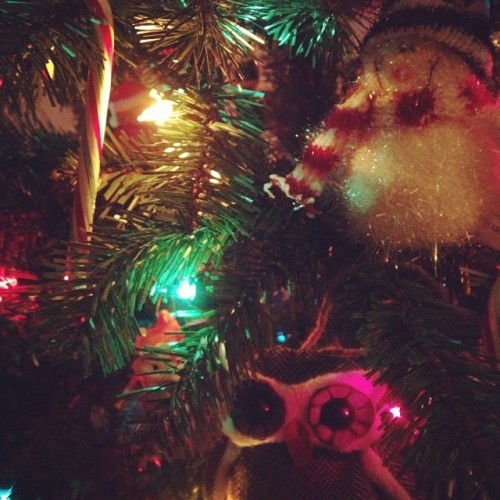
So yes, I get a little emotional at the holidays, like when I burst into tears when I found the snowman ornament, the last ornament I ever picked out with my mom. I miss her terribly at this time of year. But I also know that I will always have those memories with family, and more to create with family and friends. Nothing can take away the memory of leaning my head on my mother’s shoulder, and staring at the holiday lights with delight.

Happy holidays to you all, and I hope, if there’s anyone special you’re missing this season, you have great memories to cherish, knowing that no matter how much time passes, those will always remain.

Now let’s drink some eggnog and make merry! It's getting too real around here.

And don’t forget:

“And when Santa squeezes his fat white ass down that chimney tonight, he's gonna find the jolliest bunch of assholes this side of the nuthouse!”

Wednesday, June 5, 2013

How Much Was Mine to Keep?

"And I asked myself about the present: how wide it was, how deep it was, how much was mine to keep." ― Kurt Vonnegut

Last week, the editor-in-chief at my job called all of us in for an announcement. As I walked toward the cafeteria with my friend Logan, we joked that this was it. They must be announcing layoffs. I lined up against the wall with a pit in my stomach as I looked at the managers, and waited for them to start talking. I told myself I was being negative, but from the looks on everyone’s faces, I knew it had to be grim.

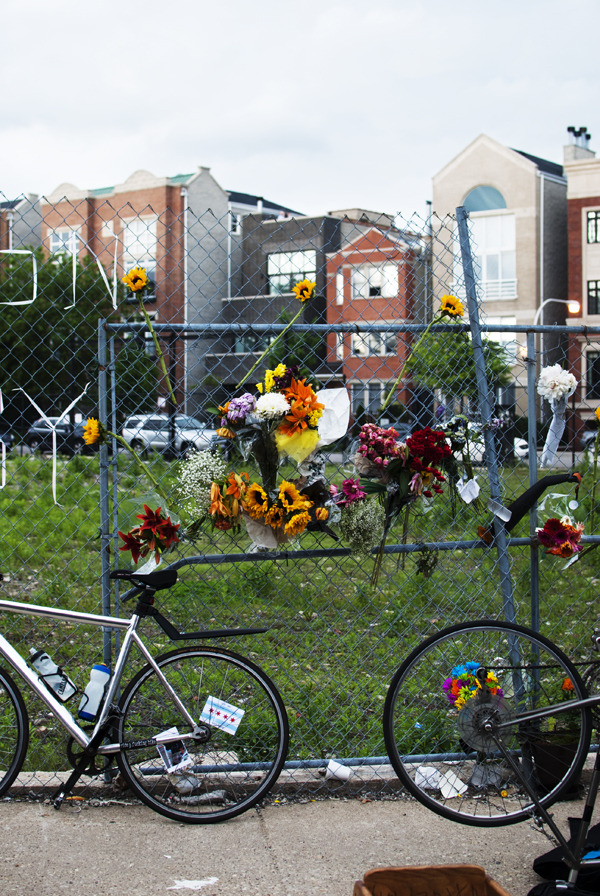
What we learned that morning was far worse than that. My coworker, 26-year-old Bobby Cann, had been killed the previous evening riding his bicycle home from work. As others cried—some quietly, some loudly and openly—I felt like I was folding into myself as I bit the inside of my cheek and forced myself not to do the same. As we all walked out of the cafeteria, the collective stunned silence was unbearable. People who had walked in late had bewildered looks on their faces. “What is it?” they asked.

I tried to answer, but could barely get the words out, the tears coming as soon as I spoke.

"Were you close with him?" someone asked, and I shook my head no.

[Memorial for Bobby, via here]

When I got back to my desk I felt sick. Someone—an oblivious coworker, I could only hope—was laughing. Everything just kept going on. But yet it didn’t. Everything felt off.

Meetings were canceled. Emails were sent. But there were still things to write, things to do. We all just kept going on.

Finally, work was over for the day. I got on the bus, surrounded by so many others, just trying to get home from work like I was. Just like Bobby had been the evening before. I felt deeply sad. Because I did not know Bobby well—no more than smiling at him as we passed each other in the hallway, or making small talk in the office kitchen—I doubted my own feelings. Why did I feel so angry? So sad? So sick about the whole thing?

As soon as I got home, I flopped on my bed and stared at the ceiling. I stared at the ceiling until I couldn’t bear it any longer, and then I grabbed my yoga mat and unrolled it. To be able to concentrate on breathing, exhales and inhales, felt like such a gift. Once it was over, I laid motionless on the mat, sweating and breathing heavily. I didn’t realize I had been crying until I stood up, several minutes later.

Finally, I allowed myself to feel all of the emotions of the day. A young man had been killed by a drunk driver, and it was tragic. I might not have known him well, but many did. So I felt sorrow for his family and friends. I felt pissed off at the drunk driver, another person close to my age who, with one horribly stupid and selfish mistake, had stolen a life and in turn ruined his own.

I felt glad to be alive. I felt selfish at the thought. I felt.

I felt.

In honor and memory of Bobby Cann, Groupon is running a campaign with Active Transportation Alliance to raise funds for more protected bike lanes in the city.

Monday, October 29, 2012

How Do You Know Who You Are?

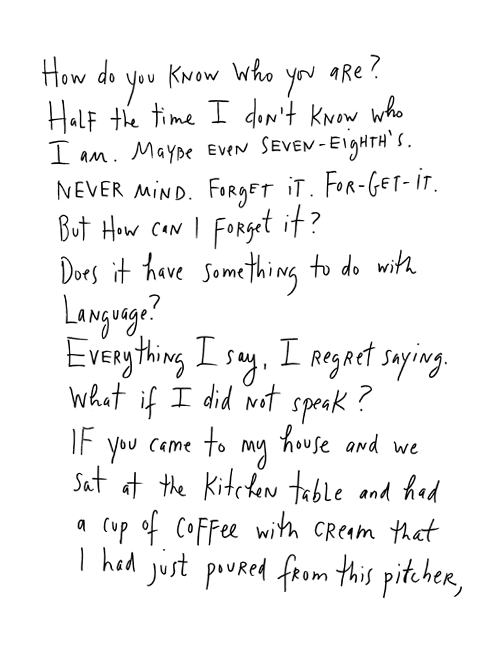
“How do you know who you are?” asks artist and author Maira Kalman in her book, The Principles of Uncertainty. I’ve not read the book, but I’ve been a fan of Kalman’s work since I first saw her blog, “And the Pursuit of Happiness” for the NYT. So when I saw this post about her at Brain Pickings today, I was once again struck by her musings.

It’s something on my mind today, this question, “How do you know who you are?”

Ten years ago today, my mother died. I dread the approach of the 29th of October like nothing else. It’s coming up, I think. Is there any way to get out of it? It’s silly, really. Well, it is silly and not silly all at once. On the one hand, it is only a day. To be blunt: my mother is still dead, every other day of the year. It’s not really any better or worse on this particular date, now is it?

Nonetheless, it is still a day—the day—that, ten years ago, marked the worst day of my life. At one moment, she was here, and the next, she was not.

So every October 29th, at some point—sometimes at multiple moments throughout the day—I feel it all over again. I feel the exact feeling in my stomach that I felt 10 years ago, when I heard a nurse say, “Her heart did stop.” It is a swift kick in the stomach. When it happened this morning, I was rubbing my eyes, convincing myself to shake off my sleepy feeling. And then: BAM. I felt it.

Thanks, October 29th. I’m awake now.

After my mother died, I began thinking of my life in two parts: before Mom died, and after. Things were one way, and then they were another. I also began to think of myself in two ways: how I was before Mom died, and how I was after. It’s really no wonder one day can seem so monumental! I’m thinking of my entire life split in pieces from it.

How do you know who you are, when you are mapping so much of your identity from this loss? I hate it. I want to stop. I think of ways to stop. But it doesn’t really work that way—instead, the elaborate daydreams begin. It’s a little game I play in my brain, where I wonder what my life would be like, what I would be like, if my mother hadn’t died.

It’s a dangerous game, this game of what ifs and if onlys—and I’m tired of it, quite frankly. Of course, it might seem completely self-absorbed that, on the day of my mother’s death, I’m asking all these questions about myself, and not her. But while it’s about me, it’s still about her, all the same.

Of course I am not the same as I was when my mom died, and thank God for that! After all, I was a teenager—18, just starting freshman year of college. Now I am closer to 30 than 20. And so when I think of the question, “Who am I?” it ties into this day so perfectly because on this day, when I particularly miss my mother and feel the utter finality of her absence, I think, I never knew my mother as an adult. She never knew me. And who in the hell am I, anyway?

I don’t always have the answer to that, but I have an idea. Sometimes it changes. Sometimes I like the answer. Sometimes I don’t.

But if my mother taught me anything, it was this very important lesson:

You can be pleased with nothing when you are not pleased with yourself.

So what if I don’t have it all figured out. So what if I can’t always exactly pinpoint the answer to the question, “Who am I?”

Today I am a woman who misses her mother. Tomorrow, I will still be that woman, but it will no longer be this day, and maybe I can think of something else. All I can really try to do is be pleased with the honest answer to the question, “Who in the world am I?” and maybe, just maybe, if I’m pleased with it, it’s not unlikely that she would be too.

Like Kalman says:


What would happen?

Sunday, May 6, 2012

Me and Tess (of the D'Urbervilles): It's Complicated

When I was in high school, my mother kept insisting that I read Tess of the D’Urbervilles by Thomas Hardy.

“You’ll love it!” she said. “It’s one of the classics.”

She directed me to the shelf where I’d find the book. “It’s in the study,” she said. Then she pointed me to its exact location. (My mother knew every book in the entire house’s exact location. It was eerie, because the books really never appeared, to me at least, in any particular order.)

I reluctantly got the book off the shelf.

Afterward, the book sat, neglected, in my room.

“Why don’t you want to read it?” Mom kept asking. She seemed hurt about it.

I never had a good answer. Ultimately, the book, like many of her books, ended up on my shelf. I finally started reading it in college about a year after she had died, but I couldn’t finish it—even though I did like it, just like Mom had insisted. I put it back on the shelf, neglected.

Soon after, during the fall semester of my junior year of college, I was required to read another Thomas Hardy book, The Mayor of Casterbridge, for one of my literature classes. I loved it, just as Mom had said I would love Tess.

Now, Tess of the D’Urbervilles rests on my shelf in Chicago, nestled between my paperback copy of The Mayor of Casterbridge and Wuthering Heights. Until today, it hasn’t come off the shelf since I last moved, two years ago. And before that, I only picked it up to move it to another shelf.

I keep moving the book from place to place. Yet other than always receiving a spot on my crowded bookshelf, it remains neglected. In between books, when I scan my shelves for the next read, sometimes my eyes cross over it, and I feel a little pang. (Why don’t you want to read it? I hear in my head.)

When I picked it up today, I flipped through the pages, wondering if there’d be a bookmark in it from my last failed attempt at reading it. As I suspected, there was—on page 220. 220! I only had 150 pages left to go.

Why didn’t I finish it? I’m sure, back when I was reading it, about nine years ago, I’d have come up with plenty of excuses: I had too much to read already, for class; I didn’t have time; I had lost interest.

But today, when I thought about what book I wanted to read next—I just finished re-reading Pride and Prejudice last night, sigh—I thought about Tess.

I think I’m finally ready.

The thing is, the longer I staunchly refused to read—or finish—the book, the longer I could still be that stubborn teenager, refusing to read the book her mom suggested to her. I’ve been scared to read it, because to read it—ridiculous as it may seem—was to admit that I can’t be that stubborn teenager any longer. To read it was to let go, to move forward. How could I finally read it without being able to call her, to hear her delight when I could say, at last, “Mom, I read Tess! I loved it.”

That phone call cannot happen. It still devastates me. But that is the reality. So really, the only thing to do is simple: Just read the book.

In my mind, she will be reading it with me.

Monday, May 9, 2011

Wake Me Up

It's either completely crazy, or completely expected, that I have a dream about my mom every Mother's Day. Each time I'm surprised, but then feel ridiculous that I'm surprised. On a day when I have heard or seen the words "mom" and "mother" multiple times, and have my mom in the back, or front, of my mind the entire day, why wouldn't I have a dream about her?

Most of the time in recent years, when I dream about my mom, I wake up feeling soothed, comforted, and safe. It's something I treasure—as though I went to sleep and got to talk to her again, even if just for a moment. I feel like she came to visit me. It's not enough, by any means, but when nothing can ever be enough, it's something.

Unfortunately, I also have a recurring nightmare about my mom. And that was the dream I had last night. Maybe it's not even really a nightmare. But it's a nightmare to me, and here's why: In my dream, my mom is back. In fact, she was never really dead, not really. This whole time, she was just gone, away, where we couldn't reach her. When I ask her what happened, she won't tell me, and she's not sorry. She's matter-of-fact: "I was gone, but I'm here now, Alison. Why are you being such a baby?"

That's what she said last night, anyway. For some reason, in the dream, I was standing in the kitchen of my grandparents' old farmhouse. The kitchen looked exactly how it looked when I was a kid. I didn't know why we were over at Grandma and Grandpa Hamm's house, but they weren't there, and Mom had decided to stay there, because she refused to come back home with us. After she asked me why I was being such a baby, she walked out of the kitchen and seemingly disappeared in the blackness of another room.

At that, I jerked awake and stared at the ceiling, terrified. I didn't want to fall back asleep, because I knew she wouldn't be there anymore. I couldn't bear to be awake. I walked into the kitchen and squinted so the numbers on the oven clock would come to focus.

2:58.

What did it all mean? Did it mean anything at all? I gulped down some water and went back to bed, only to have a series of different, equally weird dreams in which my mother stubbornly refused to make an appearance.

I woke up and felt utterly lost. And that was basically how I felt the entire day. I couldn’t quite shake that discarded, lonely sort of feeling I had felt in the dream when my mom told me to stop being such a baby. It was similar to how I felt as a kid after she’d say, chidingly, “You’re so sensitive!”

Okay, Mom. I get it.

But do you? I kept hearing her annoyingly ask back inside my head.

The whole thing was making my head hurt. I felt nuts. I wondered if anyone could tell.

***

It wasn’t until right as I left work, as I pushed through the revolving door and stepped outside, that I finally shook the feeling. It was sunny. It was warm. Who knew? I’d been trapped in my windowless cubicle of doom all day. I had no idea.

I crossed the street and stared up at the beautiful Chicago buildings. The tulips were blooming in the flowerbeds—vivid, purple and orange, one of my favorite color combinations. The wind was blowing, but it felt warm. Margot and the Nuclear So and So’s sang in my ears.

Friday, March 4, 2011

A Story With No End

This week’s New Yorker features an essay by Meghan O’Rourke. You might remember, way back in the beginnings of this blog—you know, years ago, back in February and March 2009—that I wrote about O’Rourke’s Slate series on grieving, “The Long Goodbye.”

In nine well-written, touching entries, O’Rourke wrote about losing her mother, who had suffered from cancer. When I read them, I felt both comforted and sad. In certain ways, I couldn’t believe it: Someone actually got it. Someone else out there felt all these crazy feelings I’d been dealing with since my mother died from an extended illness in 2002. I couldn’t get enough. I read the entries over and over. I emailed Meghan to tell her how much it meant to me. I blogged about it. I talked about it with my brother.

And I was pissed.

This was what I wanted to do with my grief over losing my mother: I wanted to write it. I wanted to share it with others, in the hopes that other young women whose moms had died long before their time would benefit from my story, and it would help them heal. Everything was going to be kumbaya and feelings and butterflies. I would finally think and feel, this is it! This is why I’ve gone through all this. I’m going to share my story with the world! We’re all going to grieve and cry together! Hooray for feelings!

Something like that, anyway. But seriously, this was my new life ambition, to write this book. I even wrote, way back in March 2009, “I’ll continue to love this series unless she steals my book idea.”

I’ve had my book about my mother planned, plotted, and outlined since 2008. I’ve had the title ready since 2007. It’s my secret goal and plan that I will only tell you about if (a) I really, really like you, or (b) I’m drunk. So, not so secret, I suppose. You know, because I really like everyone. I never drink.

Have I written this book yet? No. Well, yes and no. I outline it, write various essays and blogs that I’d like to include in it at some point, then I decide it’s all crap, and start a new outline. This process could go on for years. It already has gone on for years. Yet even so, when Jay sent me the Amazon link to—surprise, Meghan O’Rourke’s memoir, The Long Goodbye—I was furious. I felt like a failure. (Have we met? I’m dramatic.)

No matter that I thought her writing was great. No matter that I was comforted from reading about her mother, and her personal loss. She had done it! My plan. My goal. She had done it, and I hadn’t. What did I think, that no other young female writer had ever had a mother they loved suffer from a terminal illness? Did I actually think no one else had, or would ever, touch on this topic?

Thursday, October 29, 2009

The 29th of October

I’ve been debating whether or not to blog today, about today, all week. Because after all, today is just a day: It’s two days before Halloween. It’s my day off. It’s Thursday.

But it’s also October 29th. And for the last seven years, I’ve cringed when I heard this date. My brow furrows when I see it on the calendar.

October 29th.

Seven years ago today, my mother died. So, yeah, it’s Thursday, it’s two days before Halloween. But for me, it is now and always will be the day my mother died.

Am I being a little dramatic? Maybe. I don’t know. Is it okay to be dramatic? Maybe. I don’t know.

The fact is, I think about my mom every day. I miss her every day. But on October 29th, each year, I think about her and I miss her more. This year marks the seventh year of missing my mother, and it brings up a lot of questions.

Wednesday, April 22, 2009

“The Long Goodbye,” continued

I just finished reading the most recent two posts in Meghan O’Rourke’s “The Long Goodbye” series—“Watching Someone You Love Accept Death” and “What Is It Like To Recover From Grief?”—and though I’ve obviously been a fan of the whole series, these affected me the most. Seriously, are we the same person, Meghan? When I read this part, I actually laughed, because it was so much like something I’ve thought:
“I started feeling … better. Not 'recovered,' the way one feels after a flu. But … better. I suppose this isn't a surprise. I simply conform to the clinical norm: Studies show many mourners begin to feel less depressed around four months after the death. Knowing this makes me feel annoyed and truculent. I don't want to conform to a grief scale. I want to be an extremity. A master of grief.”
But in all seriousness, these last entries were both difficult and comforting for me to read because of how much I relate to her words.

Although I didn’t have a direct conversation with my mother about accepting her death—I was clinging to the belief that she was going to get her new lungs and heart, and somehow, everything would go back to normal—I always felt a sense of calm emanating from my mom, even toward the end. Or if not calm, normalcy: the last time I spoke with her in person was in her hospital room in Chicago, a couple of weeks before she died. I was upset over getting a “C” on a writing assignment graded by my history TA. (A “C” was not a grade I was cool with— yeah, I know I’m a big geek.) Now, if you never met my mom, it might be hard to imagine a woman on oxygen, wearing a hospital gown, getting all fired up and ranting how she’d like to have a word with him, but she did. And she did it with style. If I remember accurately, she said, “You’re a better writer than he’ll ever be!” Not that she’d even read my assignment, or read anything he’d ever written. It didn’t matter. I wasn’t kidding when I called her my cheerleader.

Anyway, everything seemed relatively normal that afternoon until later, when I realized that my dad had insisted that I talk to my mom in private, dragging my boyfriend away—we’d used a concert as an excuse to drive up to Chicago from school—and they stayed away, for almost an hour. I’ll probably never know what the hell they talked about while I sat beside my mom’s hospital bed, talking and laughing with her, but I’ll always be grateful I had that time, even if we spent the majority of time talking about school, and my new short haircut, which she loved. (I hated it.)

I managed to make it through the concert that night—ok, fine, it was a Good Charlotte and No Doubt show, and I loved it at the time—but once we started driving, I lost it. I most likely scared the shit out of my boyfriend, as I’d seemed fine until that point, but I couldn’t stop sobbing. In retrospect, I’d like to believe that deep down, I knew that I’d just hugged my mom for the last time and that’s why I freaked out, but who knows. I do know that I’ll never forget that hospital room in Chicago, or that conversation with her. That’s what matters.

***
The entry on recovering from grief was the most on point for me, though. Particularly when I got to this part:
Just the other day, nearly a week after Easter, I had to make an apple pie for a video shoot about mothers and daughters. The recipe I used was my mother's recipe, and for a day or two before I made the pie I was in a gloomy mood. I felt anxious, irritable, resentful that I had to make the pie—a pie I'd been wanting to make but was frightened of making ever since my mother died. It was absurd how much mental space this pie was taking up.

The day came. I made the pie. I pulled out the old recipe book my mother and father had given me and my brothers—the 4A Cookbook, they called it, after the apartment we lived in. And, step by step, almost as if it wasn't happening, I made the pie. I didn't let the dough chill for long enough and it came apart as I tried to roll it out. The result looked messier than usual as it went into the oven. But I felt OK; it had been strangely comforting to read my mother's words and revisit her way of making things. I loved that at the end of the recipe for pastry (butter, Crisco, flour, sugar, water) she wrote, philosophically: 'This will constitute the dough.'

But as the pie was cooking, I had a little meltdown. I was supposed to turn the heat down from 425 degrees, I remembered. But … to what temperature? Time to call Mom. I reached for the phone. And realized—I couldn't ask her anymore. From now on, I would have to answer my pie questions myself, through trial and error. The pie made my mother more absent. And yet—it also made my mother more present: When it came out of the oven, it reminded me of her.”
Seriously, Meghan? Seriously? I’m almost irritated with you for, well, being me.

My mom’s birthday fell on July 8, and every year, she’d make a flag cake that did double duty as a 4th of July cake and a birthday cake for her. She loved it. One of my favorite pictures of Mom, she’s holding up her flag cake and wearing her annual Old Navy flag t-shirt. The best part of the photo is her smile: genuine happiness. No oxygen cord.

So, on the second July 8 without her to make her flag cake, I decided I had to do it. Like Meghan wrote, “I'd been wanting to make but was frightened of making ever since my mother died. It was absurd how much mental space this pie was taking up.” It was true. All I could think about was this damn flag cake.

I dragged my roommate Diana to the grocery store with me to buy the strawberries, blueberries, Cool Whip, cake mix. We got back to our apartment and started baking the cake. Everything was fine until I had to start cutting the strawberries. Then I realized I didn’t remember how I was supposed to cut them: Do I cut them in half? What do I do? I burst into tears. Diana grabbed the knife out of my hand and cut the strawberries for me.

The next year, I made the cake with no problems. It annoyed the shit out of me. Where were the tears? Where was the stabbing feeling in my gut? Of course I know that’s ridiculous, but it’s true.

I think I’ll make the cake this year. And this time, I’ll just enjoy it. I think that’s what would make my mom happy.

Thursday, March 19, 2009

Dreams

Slate’s series on grieving continues to blow me away. Meghan O’Rourke’s newest entry, “Dreaming of the Dead,” is almost eerily on point. What she writes about dreaming of her mother encapsulates many of my personal experiences. I find it incredibly comforting.

Most specifically:
“What surprises me is how comforted I feel when I wake. I am sad that the dream has ended, but it's not the depleted sadness I've felt in the past when I've woken up from a wishful dream. I feel, instead, replete, reassured, like a child who has kicked the covers off her in her sleep on a chilly night and dimly senses as her mother steals into the dark room, pulls them up over her, strokes her hair, and gives her a kiss before leaving.”

I’ll continue to love this series unless she steals my book idea.

Tuesday, February 24, 2009

The Long Goodbye

Slate is doing a series on grieving, and the first two posts by Meghan O’Rourke are frank and well written. It really hit home with me for obvious reasons, but whether you’re “in the club” or not—and I hope that you’re not—it’s a worthwhile read.

It reminded me of this selection from Inventing Memory, by Erica Jong:

“I never thought my mama would die. She seemed immortal to me. Since she was the ground of my being, her death seemed unthinkable—however much she annoyed me at times. Now I am standing at the edge of the cliff with no one to catch me. I’m sure all daughters feel this way when their mothers die.”